
You can save a buck or two on some RV accessories, but not all. When it’s time to do one of everyone’s least favorite parts of RVing (emptying your tanks), you want the best. Not all RV sewer hoses are created equal, so today, we wanted to share with you the five best RV sewer hoses on the market. Let’s dive in!
What Is an RV Sewer Hose?
RV sewer hoses connect to an RV’s holding tank dump connection outlet to allow you to empty black and gray water tanks. Hoses are lightweight and made from thin, durable plastic for easy storage.
Are RV Sewer Hoses Universal?
Standard RV sewer hoses are 3 inches in diameter with lugs and fittings on opposing ends. RV sewer connections are generally universal, but having adapters on hand can keep you prepared for any dump station scenario. There’s a huge variety of situations at both dump stations and full hook-up campsites. Height, angle, distance from the RV, and pipe sizes frequently differ from one to the next, so it doesn’t hurt to be prepared.
Are All RV Sewer Hoses the Same?
A sewer hose is no place to skimp! A good quality hose is a worthwhile investment.
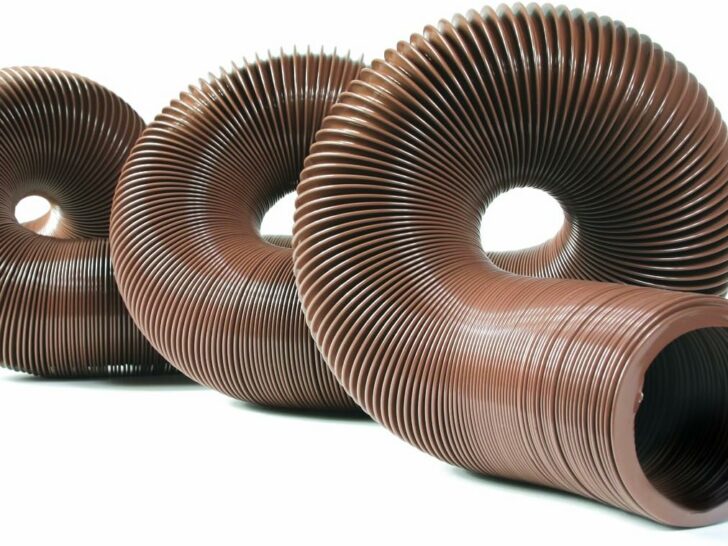
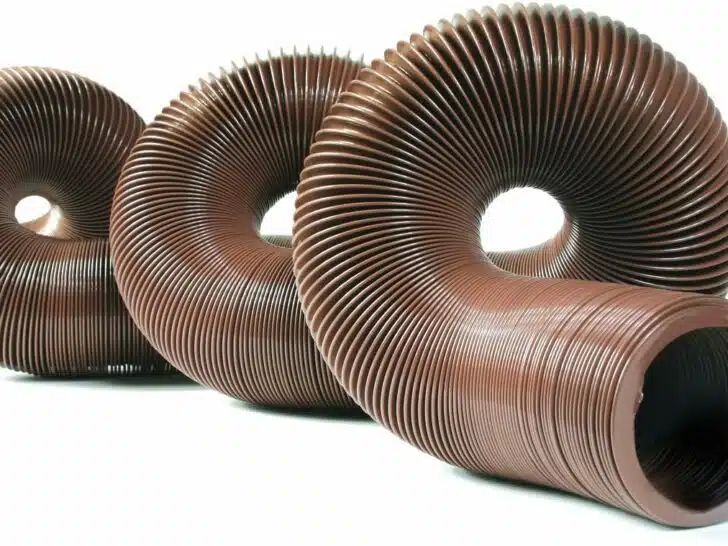
RV sewer hoses come in varying lengths, but thickness is the primary factor that sets one apart from the next. A hose’s thickness and price are often directly related. More expensive hoses sometimes offer smoother interiors for optimized flow and ease of cleaning.
Manufacturers measure sewer hoses in “mils,” which can be confusing if you’re not familiar with this unit of measure. An article from Global Plastic Sheeting states, “A mil is a measurement that equals one-thousandth of an inch or 0.001 inches. One mil equals 0.0254 mm (millimeter).”
Continue reading their guide to plastic sheeting measurements to understand how to measure your hose.
How Long Should an RV Sewer Hose Be?
The most common lengths for RV sewer hoses are typically between 10 and 20 feet. You’ll want to make sure you have enough hose to reach the dump station, or campsite sewer hook-up, which is simple if you consistently hook-up or dump at the same location.
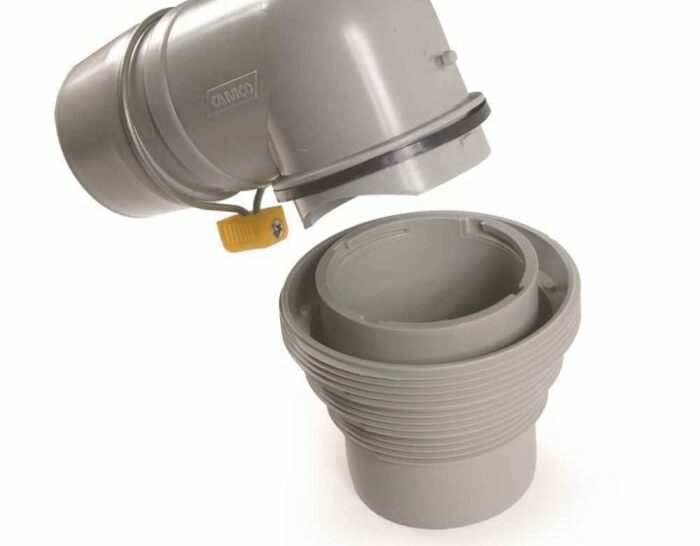
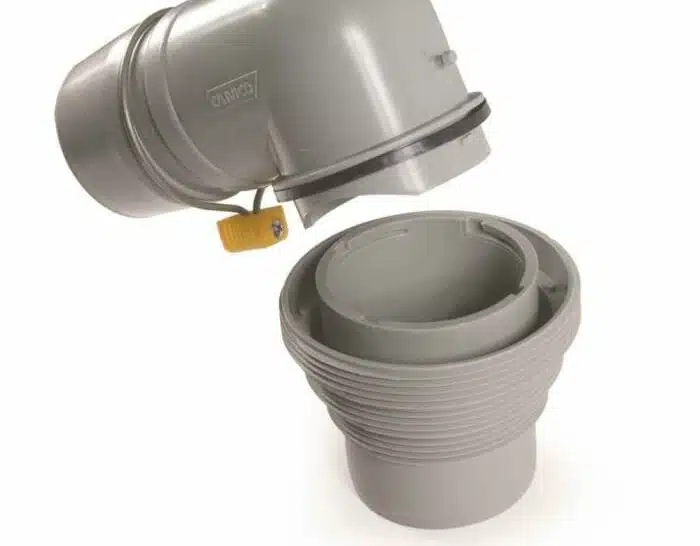
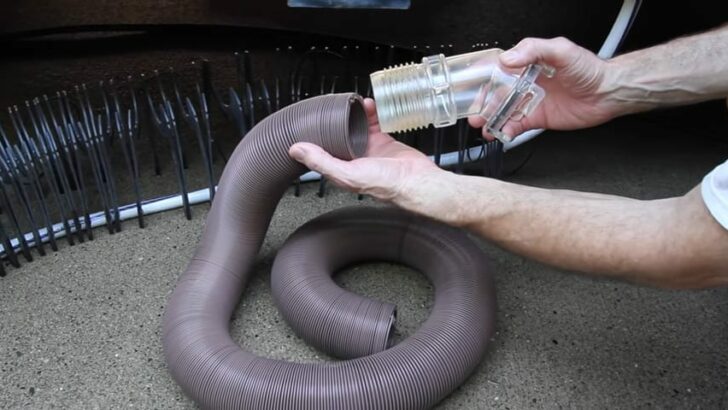
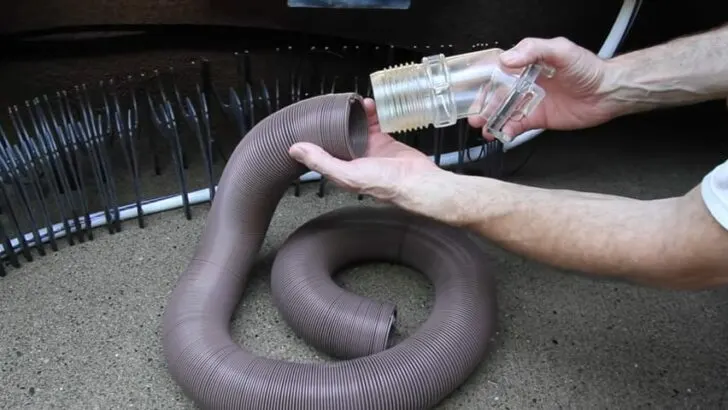
Adapters are important to have on hand, to ensure that you’ll be able to make a good fit between your hose and the dump station. Shown is a 4-in-1 dump station fitting.
If dumping, or hooking up, at different locations on a regular basis, you’ll probably want to skew toward a longer hose, like the 20-foot hose we use as full-timers. The location of your RV’s sewer outlet, and the location of the dump station, or campsite sewer hook-up, are important. Some sites have sewer hook-ups that are very far back. This requires a longer hose, especially if your RV’s water compartment is in the middle of your rig.
What to Look for in an RV Sewer Hose?
All RV sewer hoses have the same purpose, but they’re not all created equal. We want to share with you some essential things to consider when purchasing an RV sewer hose.
Ease of Use
Emptying your RV tanks should never be taken lightly. You also don’t want your equipment to be overly complicated. When selecting a sewer hose, look for a product that will quickly and efficiently transfer your RV waste into the dump station.
Portability/Storage
When you’re not using your sewer hose, you want it out of sight and out of mind. Thinner hoses generally take up less room than thicker hoses, but they can also be more prone to being damaged/punctured.
No matter what length or thickness you select for your hoses, have a storage plan. Many RVs come with storage tubes mounted under the rig or a designated space inside the bumper. Our RV has a hose storage sleeve built into the side of the bodywork. It’s a great feature, but does require that at least one end of the hose be left free of any type of permanently-attached adapter, so it limits our choices.
Ease of Cleaning
It could probably go unsaid, but the last thing you want is raw sewage sitting in your hose for extended periods. Flushing water through your tanks and hoses is the best way to keep them clean. For optimal sanitation and ease of cleaning, you can connect external attachments to help.
Various Attachments
You’ll want to have some attachments to handle potential scenarios you might encounter at dump stations and campsite hook-ups. A clear elbow, for example, lets you keep an eye on the flow of waste when emptying your tanks.
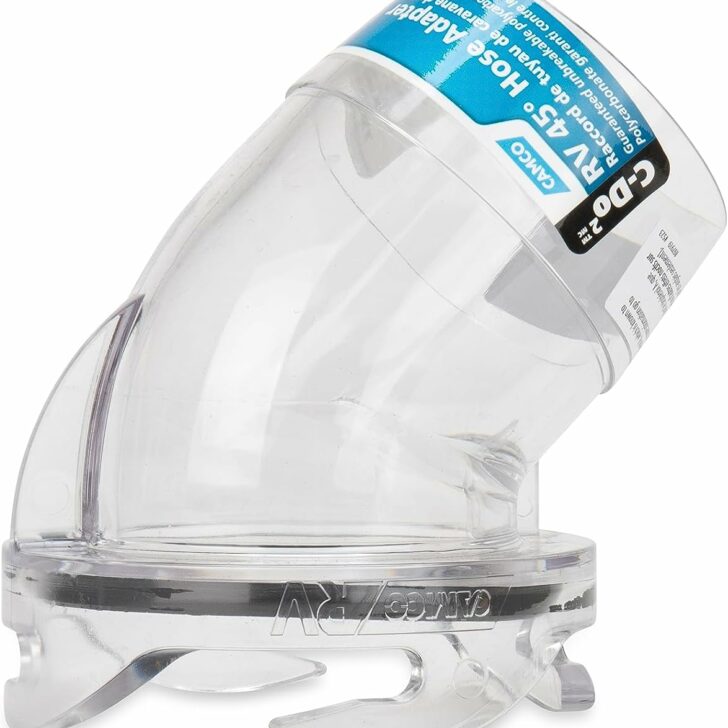
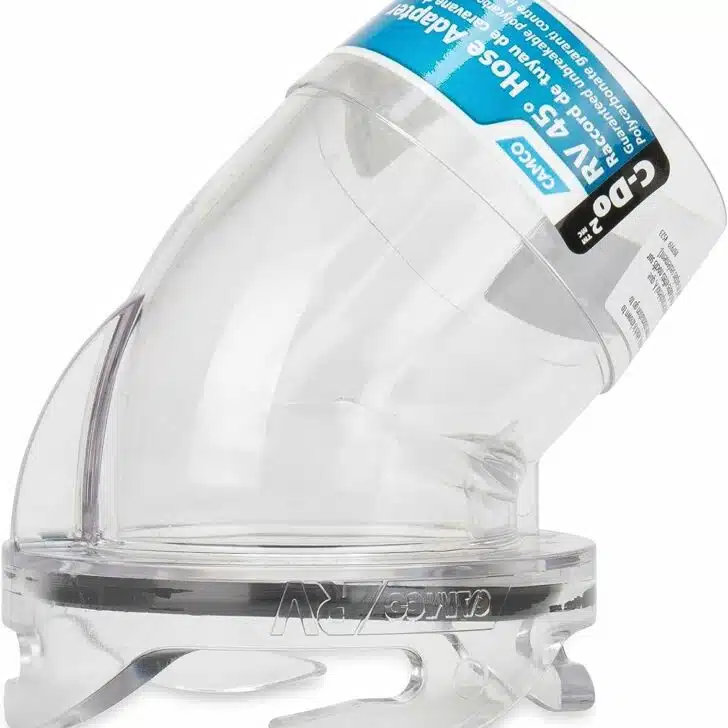
A clear elbow allows you to see when clear water is running through the hose, indicating that the rinsing is complete.
At some point, you’ll likely encounter a sewer connection that’s very far from your RV’s sewer outlet. So coming prepared with an additional hose is a great purchase as well, along with a connector to join them. Other attachments that are important to have are a rubber doughnut for a secure fit into the drain and a weight to keep your hose connected to the drain, if it’s not threaded.
5 Best RV Sewer Hoses
Now that you’re more familiar with sewer hose options and their necessity, let’s look at some of the best-value quality sewer hoses on the market. After all, a poorly-made hose can make a real mess of things – literally!
1. Lippert Waste Master
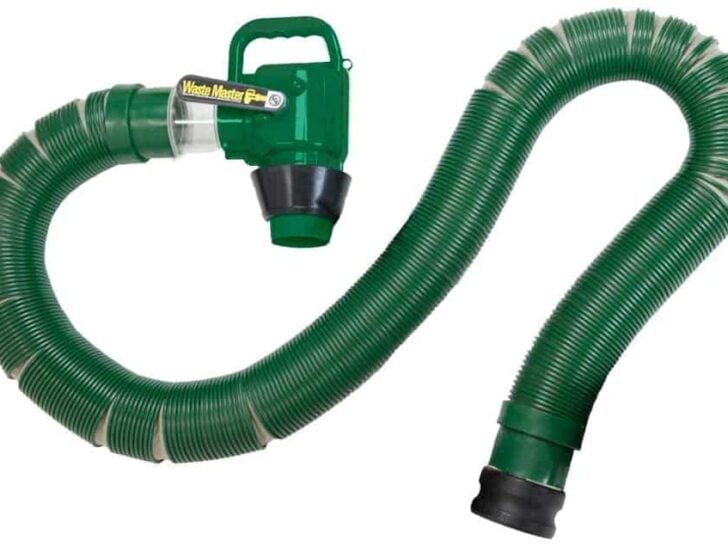
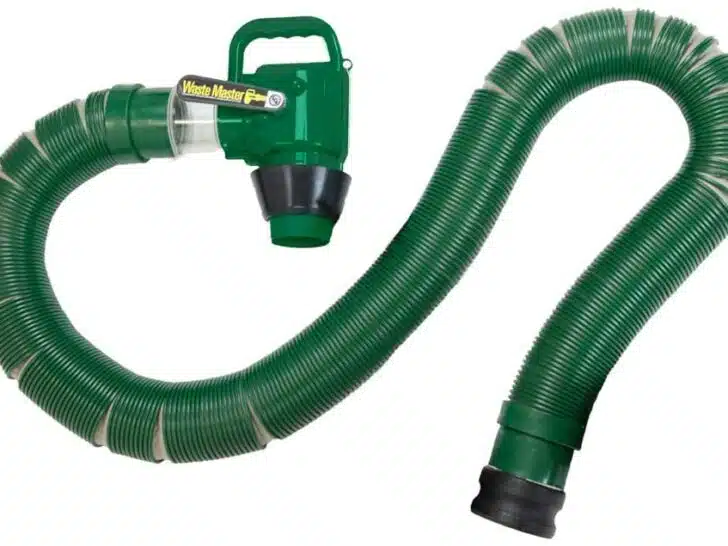
This 20-foot sewer hose collapses to 5 ½ feet for easy and compact storage.
This 20-foot sewer hose collapses to 5 ½ feet for easy and compact storage. The cam lock creates a secure connection and eliminates the possibility of a leak, while the patented design provides a smooth interior surface to eliminate trapped waste.
A 90-degree discharge port allows you to connect to any sewage inlet easily. With a thickness of 23-mil, you’re getting a durable hose that will last a long time. The rubber doughnut, built-in handle, and puncture-resistant material make this a top contender for the best RV sewer hose.
2. Valterra Viper
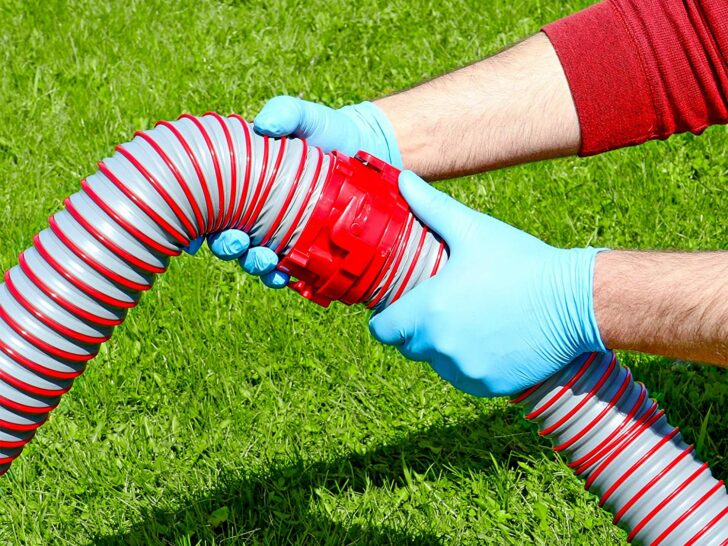
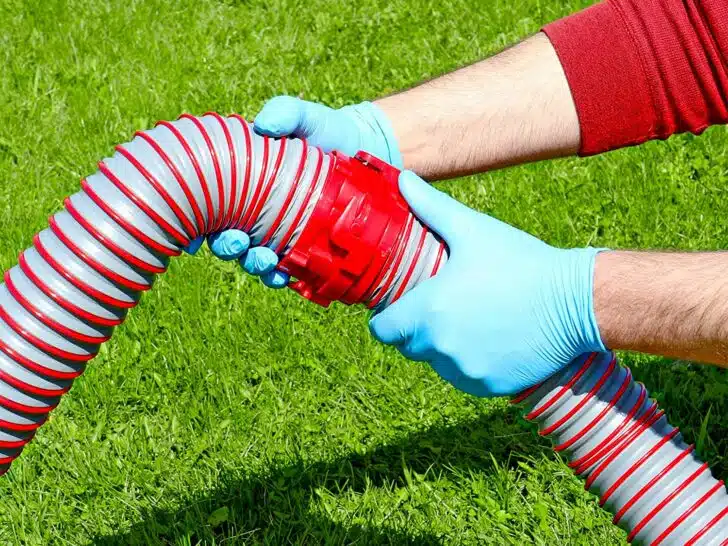
This 20-foot RV sewer hose kit includes 2 attachable 10-Foot Hoses with rotating fittings.
Get everything you need in this kit to start emptying your RV tanks, including a pair of 10-foot sewer hoses. Individually these hoses are the perfect option for unloading at the dump station as you exit a campground.
If you’re lucky enough to have a full hook-up campsite, they give you plenty of length together. Plus, the 90-degree adapter allows convenient access to sewage inlets. The included end caps will prevent leakage while in storage. And the rotating fittings make it easy to get the hose attached at both ends.
It’s a strong kit as well. The 25-mil tubing is wrapped with 135-mil protective beading to provide optimal strength. Don’t worry if you find yourself camping in colder temperatures; you can use this hose even at -20 degrees Fahrenheit.
3. Camco RhinoFlex
Camco is well known for its RV accessories and is a contender for the best RV sewer hose.
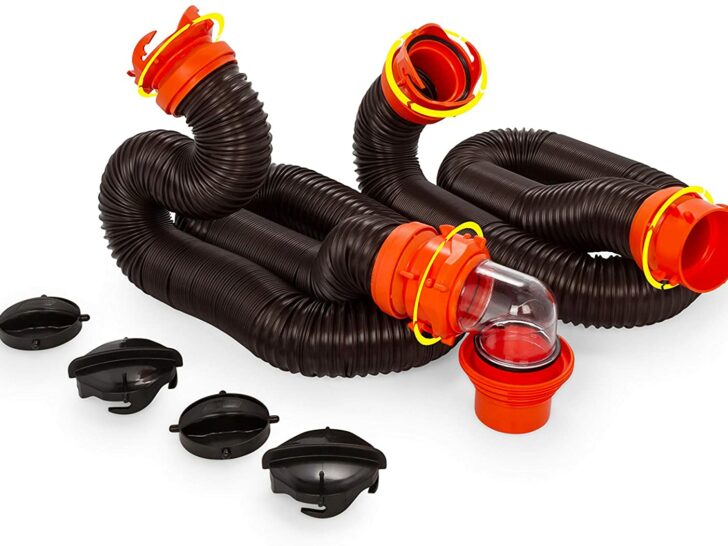
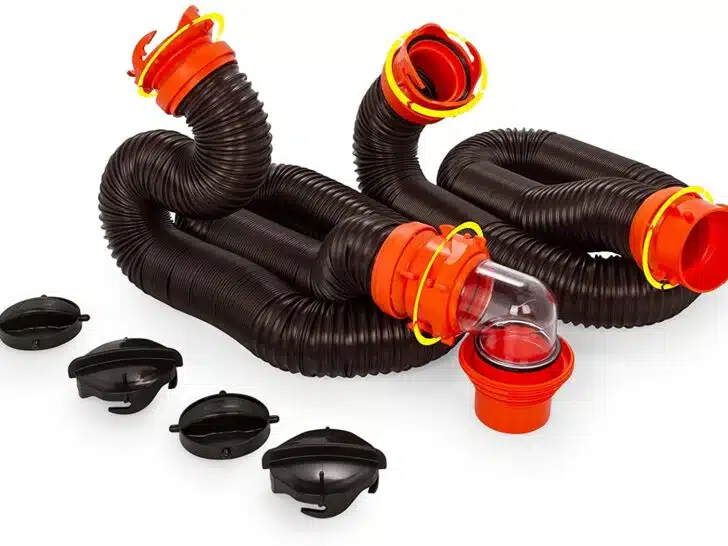
The Rhinoflex kit includes swivel fittings, clear elbow and 4-in-1 sewer outlet fitting.
The RhinoFlex is made of 23-mil polyolefin and reinforced with steel wire. You’ll love how conveniently the RhinoFlex is stored as each 10-foot section compresses to just 39 inches. This kit also includes a transparent 90-degree elbow to monitor proper flow.
Best of all, you don’t have to pay triple digits to get a quality RV sewage hose. And the fittings on each end fit securely and are compatible with many after-market attachments, so you won’t have to pay extra for new or brand-name add-ons.
4. Thetford Titan
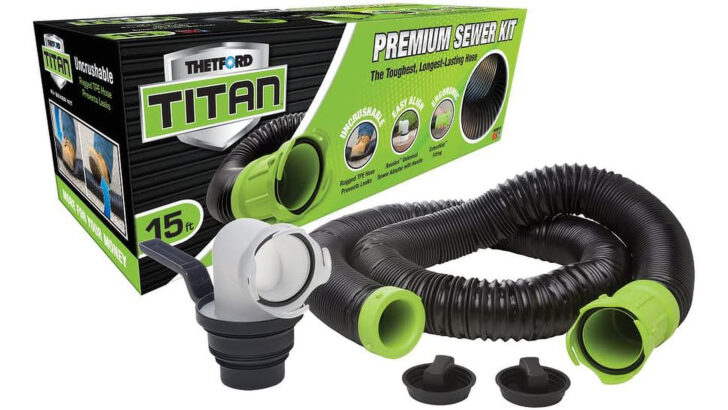
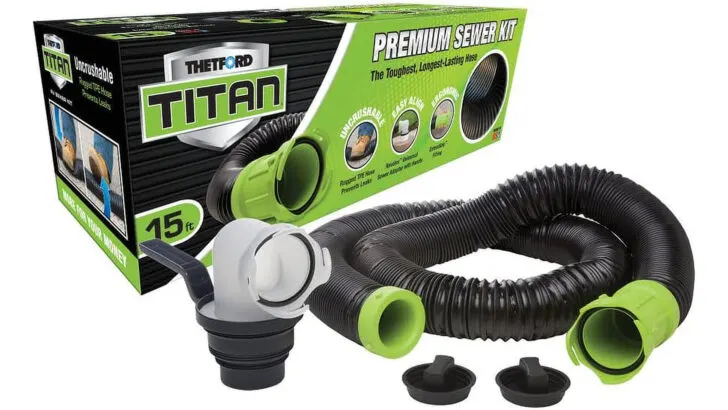
The 15′ Thetford Titan is strong but it won’t break the bank.
This 15-foot rugged sewer hose is incredibly durable and could be the best RV sewer hose on the list. RVers love it because of its durability — it returns to its original shape even after being run over by a car!
An ergonomic 5-in-1 sewer adapter allows for easy connection at any sewage inlet. Thermal Plastic Elastomer (TPE) is a proprietary technology that renders the Thetford Titan puncture and abrasion-resistant. The kit also includes two press-fit end caps to eliminate leaks and odors.
Overall, the Thetford Titan is budget-friendly but a high-quality RV sewer hose.
5. Camco Rhino Extreme
If you’re looking for a quality kit at an extremely affordable price, look no further. The Camco Rhino Extreme provides everything you’ll need right out of the box.
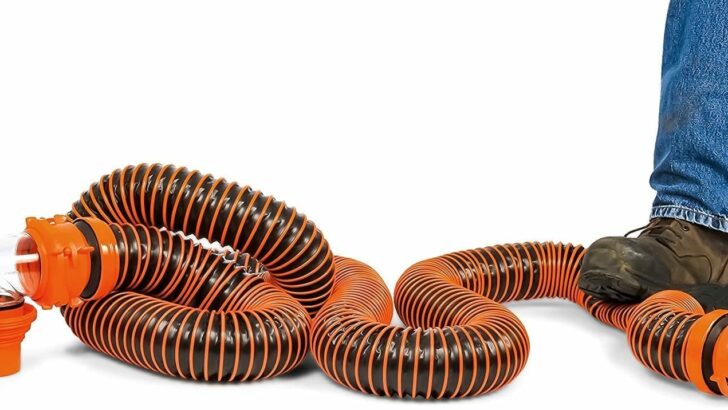
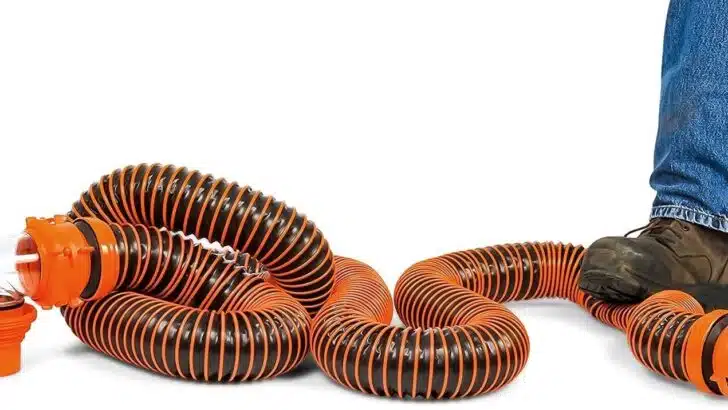
The RhinoExtreme is durable and comes with several accessories.
The Rhino Extreme is exceptionally durable and resilient. It won’t dent or rust and can withstand incidental crushing or other accidents. The hose also works in extreme temperatures, functioning in temperatures as low as -40 degrees Fahrenheit.
In all, it’s a fantastic kit for regular or occasional use.
We know that the next time you pull up to the dump station (or need to use your portable RV dump tank), you’ll be better prepared with any of these hoses. You’ll have everything you need to make your dump experience a smooth and painless process.
Geek Out with Us Every Week
Join our newsletter to learn about all things RV-related. Every week we offer free tips, tricks, product reviews, and more to our online community of RVers. Whether this is your first time on the road or you’re a seasoned expert, we’d love for you to geek out with us!
Craig Phillips
Monday 14th of November 2022
Rhinoflex connection fittings to the hose fail. I've had two that have come apart and no amount of duct tape fixes the problem. Avoid buying!
Fay Kelley
Wednesday 12th of October 2022
I have purchased three 10 ft camco rhino hoses during the past year. All started leaking like a sieve in a month. The longer ones I bought 3.5 years ago are just now going bad. The newer ones are terrible quality. One bad one purchased at Walmart and the other two from Amazon. I have 3 tanks and need to T in two places. So I need various length pieces. And a long ways to hookup. Wish I could find a better solution.
Pat Parker
Wednesday 10th of March 2021
Great info as always. We always use camco rhino flex
JOHN SCHRETLEN
Wednesday 10th of March 2021
Thanks for showing us some quality sewer hose options. It pleases me to know that I'm already using one of your choices (#3).
When looking to replace a leaking connector and buy new hose I had only two prime needs: it had to be a better quality reputable hose that does not kink easily and it MUST slide easily into the storage tube of my coach.
That meant that one could have a small connector but the other end had to be just hose. My storage tube has a 90° angle just inside the access door and tilts slightly downward toward the drive tires. I've never had any binding issues with the Camco hose.
Dave
Wednesday 10th of March 2021
Thanks, good recommendations, particularly on quality hose. There’s a surprising amount of pressure when dumping, and having a blowout is not a place I want to be. Personally I find it easier to carry two 10’ than a 20’. Trying to wind a 20 footer to a dump station that’s only 5 or so feet from the coach can be challenging. Our small coach doesn’t have a storage tube, so two 10 footers that collapse like the Camco work well for me, and collapse smaller than the 20’ can. The 10’ collapsing to 39” is small enough for me to cap them then put them in a plastic box for storage.