


Class B Plus RV? Hmmm…
In general, when the various classes of motorhomes are discussed, Class A, B, and C RVs are covered, as well as travel trailers, fifth wheels, and toy haulers. But motorhomes are limited to Class A, B, and C rigs. Or are they?
We know that Class A RVs are the largest and most luxurious of the three classes of motorhomes (with diesel pushers sitting at the top of that class), Class B is the smallest (often referred to as a campervan), and Class C is the middle child, usually distinguished by a bed or entertainment center/storage covering the entire area over the cab.
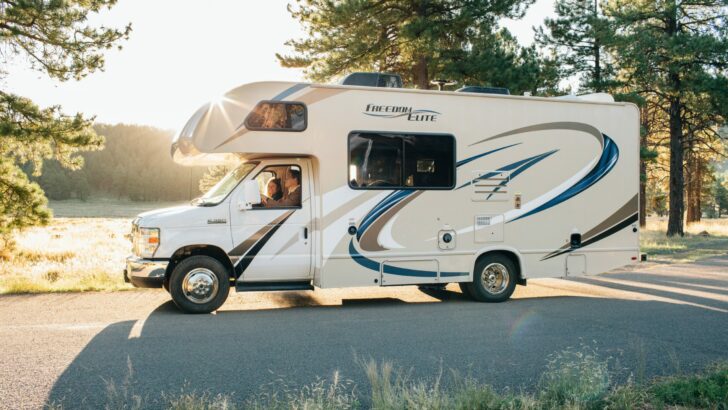
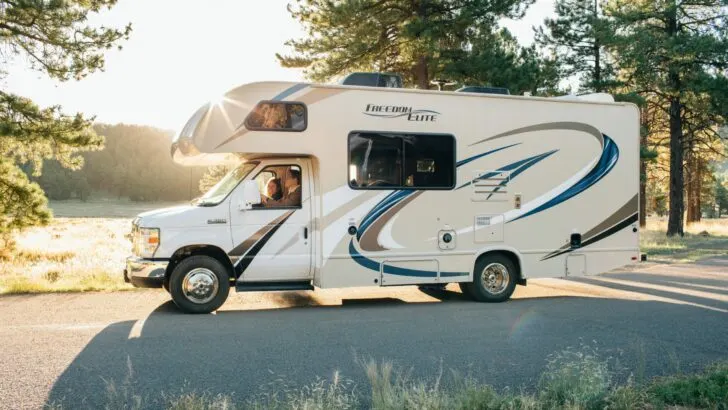
Note the large cab-over area of this Class C RV. The fact that it extends almost fully over the cab distinguishes the look of Class C RVs from that of Class B Pluses.
But you’ve probably been hearing of a newer “class” of RV, notably the Class B Plus (or Class B+). But what exactly is a Class B Plus RV, how will you know one when you see one, and why might you want one?
In today’s post, we’re covering the ins and outs of the Class B Plus motorhome – what it is, how it differs from Class A, B, and C RVs, and what would it cost to buy one?
- 1) What is a Class B Plus RV?
- 2) What’s the Difference Between a Class B and Class B Plus?
- 3) How Big Are Class B+ RVs?
- 4) Features and Amenities of a Class B Plus Motorhome
- 5) How Much Does a Class B+ Cost?
- 6) How Many People Can a Class B+ Sleep?
- 7) Are Class B Plus Motorhomes Good for Full-Time Living?
- 8) Conclusion
What is a Class B Plus RV?
From the perspective of federal regulations, a Class B Plus motorhome is technically a Class C RV. Let’s say that again for the sake of clarity.
A Class B Plus is technically not in a class of its own but is instead a type of Class C RV. All federal regulations that apply to Class C RVs apply to the Class B Plus category of RVs, too.
Now that we’ve dropped that little bombshell absorbed that interesting information, let’s take a look at what makes an RV a “Class B Plus”!
As you might imagine, the term “Class B Plus” refers to a motorhome that sits somewhere between a Class B and a Class C RV. Like the Class C, the B Plus is wider than a Class B and is built on a truck chassis.
Unlike Class C RVs, the Class B Plus doesn’t have a bunk (or storage/entertainment area) stretching all the way over the cab. And that obvious structural difference is pretty much how you can tell the difference between a Class B Plus motorhome and a Class C motorhome when you see one driving down the road.
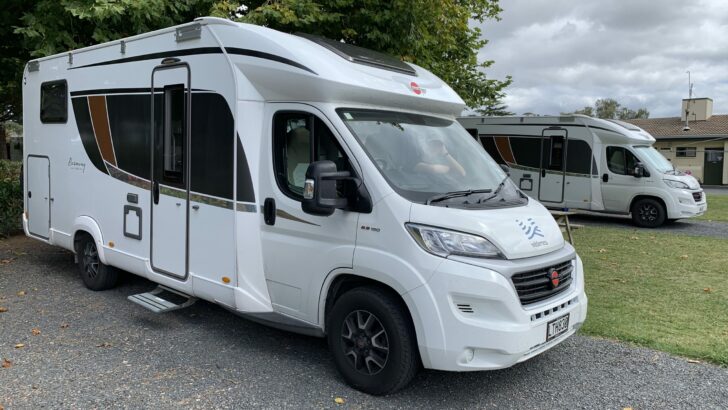
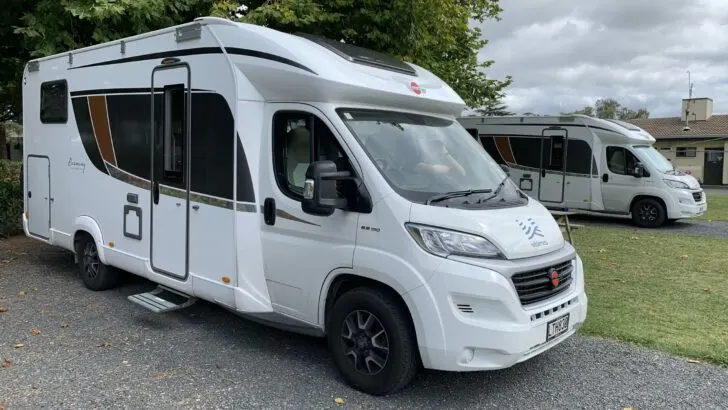
Note the difference in this Class B Plus RV from the cab-over bunk in the photo of the Class C posted above. This Class B Plus, built on a truck chassis cutaway, has a smaller area over the cab that isn’t spacious enough to accommodate a bed or entertainment center but generally provides additional headroom. These two rigs are the ones we explored New Zealand in with our friends Tom & Cait Morton.
But what’s the difference between a Class B and a Class B Plus?
What’s the Difference Between a Class B and Class B Plus?
As we’ve established, a Class B Plus is built on a truck chassis. A Class B RV, on the other hand, is built from a van. Often referred to as a camper van, Class B RVs are essentially long, high-top vans made into motorhomes with all (or most of) the features of a larger RV but in a smaller package. The traditional Class B RV contains all of the features of a motorhome within the van body, without any additional walls, floors, or roofs added in.
As a result, Class B RVs pack their bathrooms into tight spaces, which is why most have a wet bath — that is, a shower, toilet, and tiny sink occupying one small space (and yes, they all get wet when the shower’s used, hence the term “wet bath!”).
Class B RVs typically have smaller refrigerators, two-burner propane stoves, and storage everywhere there’s a space for things to be stored. They usually don’t have the space for a dedicated dinette, but they do often have front captain’s seats that swivel around to face the rear of the RV and small tables (sometimes one in the front and a second in the back) that can be placed in use or stored.
Class B Plus rigs can be laid out somewhat similarly, but because they’re wider, longer, and taller, differences are afforded by the additional space. For example, a Class B Plus might have a little dinette, a larger refrigerator, a slide, and sleep 1-2 more people than a Class B RV could sleep. (All of this depends on where you obtain your information. More on that in a moment!)


In New Zealand, in our rented Class B Plus RV, we’re enjoying a meal at the dinette with our dear friends Cait and Tom Morton of Mortons on the Move. As you can see, the Class B Plus allows for an extended dinette area due to the additional width.
One of the most appreciated features of a Class B Plus compared with a Class B is that a Class B Plus is often large enough to accommodate a dry bath, that is, a separate toilet and shower area (so you’re not showering all over the little sink and toilet as you would in a wet bath).
Class B Plus rigs also tend to offer more storage on both the interior and exterior of the motorhome and somewhat larger fresh, gray, and black holding tanks as well. In addition, the larger chassis affords the Class B Plus motorhome more towing capacity and a greater GVWR (Gross Vehicle Weight Rating).
When reviewing the differences between a Class B and B Plus, it’s easy to see why the Class B Plus is technically classified as a member of the Class C family. The B Plus is quite clearly more like a Class C than a Class B.
How Big Are Class B+ RVs?
A typical Class B Plus motorhome is between 23’ and 25’ in length, but they can be longer. They’re generally easy to park and maneuver through city streets or over terrain that may be a bit more remote.
There are versions of the Class B Plus that are able to accommodate a slide or two, offering even more room to the interior living space. The larger the Class B Plus rig is, the larger the holding tanks tend to be, and the more storage and sleeping capacity the rig affords.
Most Class B Plus motorhomes come with exterior storage large enough to accommodate such things as bicycles, kayaks (especially inflatable ones), and golf clubs. And, they’re typically designed to comfortably travel and sleep 2-4 people, whereas Class C RVs are large enough to accommodate more.
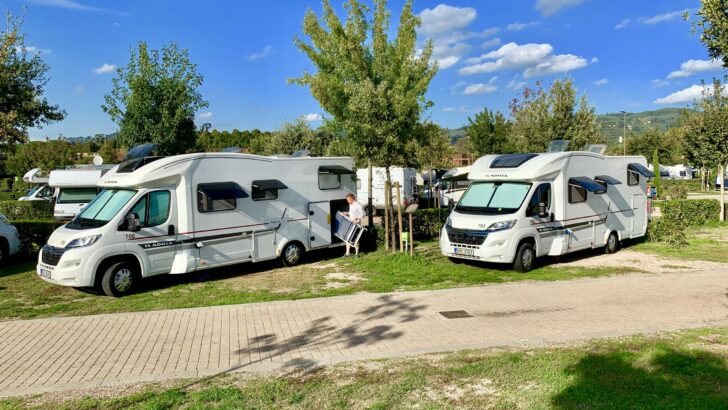
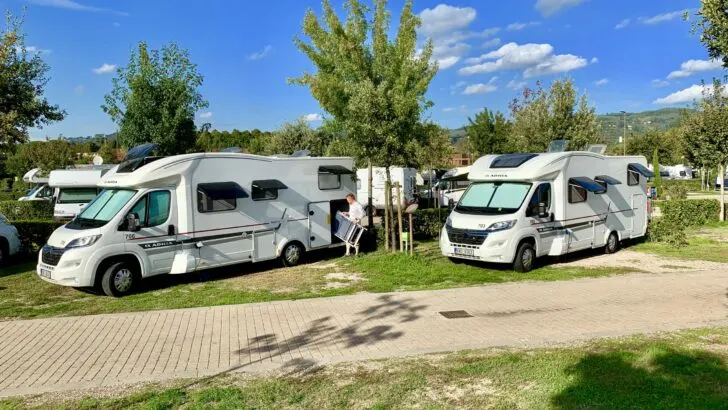
Shown here are the Class B Plus RVs we rented to travel around Italy with our good friends Heath and Alyssa Padget (and Ellie!). If you look closely, you’ll spot Heath loading chairs into the rig’s large outdoor storage area. Class B Plus motorhomes are long enough and wide enough to offer spacious, deep storage areas.
With all of that said, if you do a little research online, you’ll find lots of conflicting information on Class B Plus rigs. Some articles say they’re built for no more than two people. Others say the larger units have slides and plenty of room to sleep four or more.
The truth is this: The Class B Plus evolved from requests from folks in the market for a Class C-sized rig who were asking for a Class C without the over-cab piece. So a Class C-sized RV with a cutaway truck chassis was designed, and the term “Class B Plus” was born, strictly as a marketing tool.
That’s right — it’s a made-up marketing term to indicate the design difference and to appeal to a particular audience. (Reminder: these so-called “Class B Plus” rigs are technically Class C RVs.)
So, it’s no wonder that the details of Class B Plus motorhomes vary depending on who’s reporting. A “Class B Plus” isn’t so much a specific entity as it is a marketing tool.
Features and Amenities of a Class B Plus Motorhome
Class B Plus rigs are often marketed as small luxury RVs with many of the amenities of a Class A rig, only smaller. Class B Plus RVs are indeed often high-end, small motorhomes for sure (and their prices tend to reflect this – more on that in the next section).
A Class B Plus motorhome has a permanent bed, most often a queen, though some manufacturers have begun to offer Murphy beds which make for additional interior space during the day. Some are all-wheel-drive, and many have features such as lighted awnings, roof-mounted solar panels and inverters, larger refrigerators than their Class B counterparts, entertainment centers with storage over the back of the cab area, dinette lounges, high-end galley (kitchen) amenities, and fairly spacious showers.
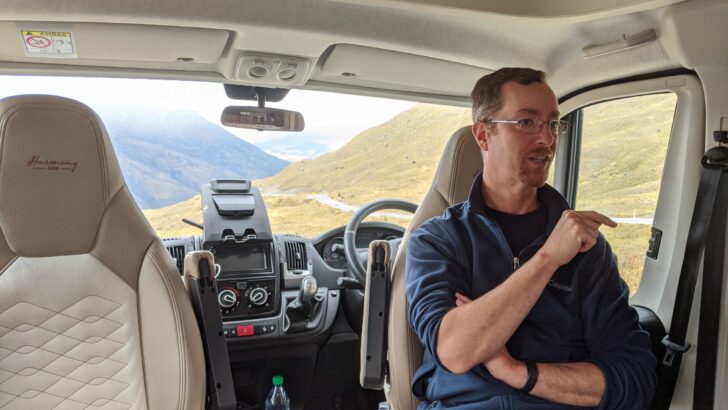
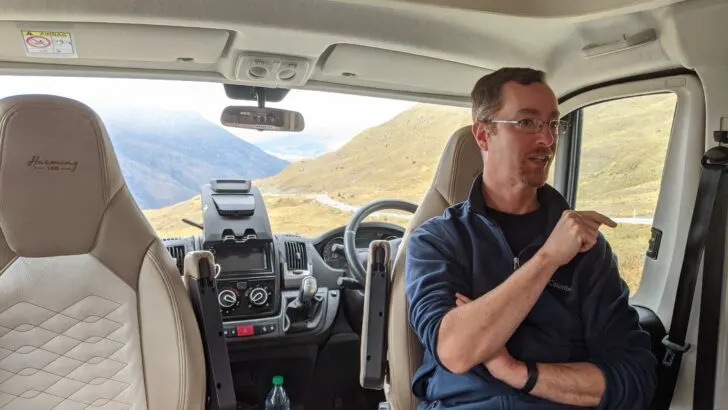
In a Class B Plus RV, the driver’s and passenger’s seats swivel to offer additional lounging space in the front of the RV.
Many of the Class B Plus motorhomes offer European design, with sleek exterior lines and relatively fine interior finishes.
How Much Does a Class B+ Cost?
Many people look toward the Class B Plus as a nice midway between the smaller, van-like Class B and larger, more boxy Class C RVs with what they suspect will be lower cost compared with the Class Cs. Not so!
Class B Plus motorhomes are often priced quite high, running anywhere from $70,000 to $200,000 (most running over $100,000), depending on the manufacturer and amenities.
A Class B Plus RV may afford you a sweet ride and a relatively luxurious small motorhome, but it won’t offer you a budget RV by any means, and it won’t save you money over a Class C. Class C RVs are almost always less expensive than Class B Plus RVs.
How Many People Can a Class B+ Sleep?
We touched on this earlier in the article, but most Class B Plus RVs are designed to accommodate two adults and maybe a small child or two comfortably (in the converted dinette), though some manufacturers offer floor plans which can sleep three or four adults.
Note: seatbelts provided in the dinette area allow for more than two people to travel safely as well, but be sure to check the specs for any unit you’re considering buying or renting before assuming.
Are Class B Plus Motorhomes Good for Full-Time Living?
This is a tough question for two guys who live full-time in a 43-foot diesel pusher. Obviously, we prefer a fair amount of room for full-time living, working, and traveling (although we’d happily downsize if there was a 35′ Class A diesel pusher floorplan we actually wanted).
With that said, while traveling outside of North America, we’ve traveled and lived in Class B Plus RVs for several weeks at a time, and we were quite comfortable.
Would we want to live and work full-time, day after day, in a rig that size? Probably not. But lots of people live in vans and Class B RVs full time – and even in minivans, cars, and SUVs — and we’re pretty sure they’d consider living full time in a Class B Plus RV quite a luxury.


A minivan camper we saw while traveling in New Zealand. Some folks are perfectly content to travel in this small space, spending most of their time outside enjoying the breathtaking views of enchanting New Zealand… or wherever!
Conclusion
Despite the fact that it’s sort of a “fake” class created as a marketing tool that actually belongs to the Class C family, a Class B Plus RV is a great traveling rig with just the right amenities for the right travelers. Larger, and therefore roomier, than a Class B RV, and less boxy and top-heavy than a Class C RV, the Class B Plus motorhome offers plenty of comfort and ease of driving that delivers just the right balance for many RV owners and renters.
Geek Out with Us Every Week
Join our newsletter to learn about all things RV-related. Every week we offer free tips, tricks, product reviews, and more to our online community of RVers. So, whether this is your first time on the road or you’re a seasoned expert, we’d love for you to geek out with us!
Sandra Chabvepi
Thursday 26th of January 2023
Hello guys, I am from Albuquerque New Mexico in the US. And I just learned more about the class plus add the difference between the class an and class B RV, thank you newsletter it’s been a helpful information. I own a class plus RV my husband and I has lived in it for over 10 years. It’s a little tight for two people, but we managed, since my husband has passed away in 2018, I now live alone in it. And it is beautiful. I have fixed it up like a tiny home. And will soon be traveling across the US with it.
John Schretlen
Saturday 28th of August 2021
What I learned today:
That a Class B Plus motorhome is a marketing tool built on a truck chassis. That a Class B Plus is, to be honest, ideal for two adults if travelling on a holiday for a month or two. That a Class B Plus used full time would be best for one person.When renting RV's in Europe we got a unit similar to what you had in Italy. I found, as you probably did too, that coming from a large DP coach everything seemed small. But tidy and comfortable. There were also some fun and amazing features that I had not seen at any RV show in North America.
Thanks for an interesting and informative Saturday morning read.
TheRVgeeks
Saturday 28th of August 2021
Hope the read went well with breakfast & coffee, John! ????☕️
Mike
Saturday 28th of August 2021
Sooooo .... A Class B+ is really a Class C- but they don't want to attach a minus stigma to it because it wouldn't do well as a marketing strategy. Don't ya just love marketing 'professionals'?
TheRVgeeks
Saturday 28th of August 2021
LOL! Hadn't thought of it that way, Mike. But yeah, you're right... a Class B+ RV is really a Class C-... which surely doesn't have as nice a marketing ring to it! ????