
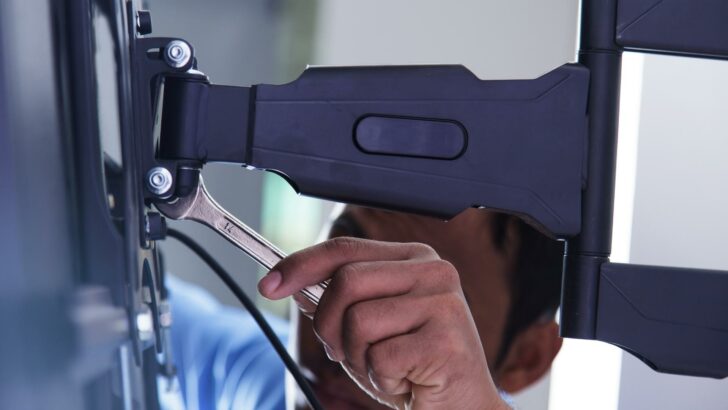

Mounting a TV in an RV often isn’t much different from mounting a TV in a sticks & bricks house. The fact that RV walls are built differently does come into play to some degree, of course. But the biggest factor is that the television needs to be mounted and secured in such a way that it can survive the constant rumbling and movement over all types of terrain caused by the twists, turns, and roadways of a home on wheels.
So, today we’re addressing the DIY project of attaching a TV mount to your RV walls and securing your flat screen TV in such a way that it survives life on the road.
Let’s get right to it before you miss your favorite shows!
Why Mount a TV in Your RV?
Most campers aren’t interested in watching a whole lot of television during the event-filled days of a camping trip. But let’s face it – most of us enjoy relaxing in front of the TV in the evening whether it’s to catch up on the news, the latest sporting event, or episodes of our favorite show.
We live in our RV full time, so obviously we want to have a TV in our rig. But even part-timers often enjoy some amount of relaxing in front of the tube. How about a movie on a chilly, rainy Saturday afternoon?
Maybe you’d like to check in with your favorite YouTube channel for some DIY RV maintenance tips. Or maybe you’re roadschooling the kids and you’d like to take advantage of some other instructional videos. Of course, these can be seen on a computer or mobile device, but sometimes a big screen is just more satisfying, especially for watching by more than one person.
Many modern TV sets can even be used as a computer monitor if you’d like to get some work or web surfing done.
So, there are lots of reasons to mount a TV in your RV.
How to Find the Best Mounting Location for a TV in an RV
This is one of the most important aspects of mounting a TV in an RV – the location. Remember – RV walls aren’t the same as walls in a house. They’re thinner and made of different materials.
In some RVs, there may be a sticker to indicate where in the RV it’s most appropriate for the installation of a television set. This is where the manufacturer has pre-set some reinforcement such as a metal plate, a piece of plywood, or even wall brackets specifically placed for the installation of your TV’s mounting plate.
But not all RVs have this type of built-in reinforcement. In these cases, it may be necessary to use a stud finder to locate the studs behind your chosen TV wall.
In a previous post entitled Can You Hang Things on RV Walls?, we thoroughly discussed RV walls and laid out several ways to find studs in them. These include using your hands or using the stud markings on the outside of your RV.
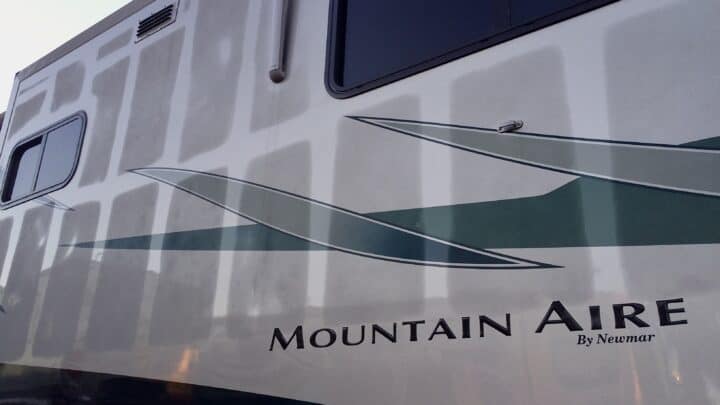
In the early morning dew, we can often see the outline of the studs in our Newmar Mountain Aire.
You can also use tools you may already have handy such as a stud finder or an infrared thermometer.
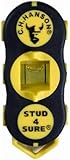
- Small and compact, easily fits in pocket
- 2 way level for ease of marking
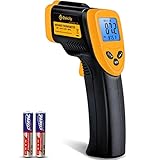
- Better Accuracy: The Lasergrip’s 12:1 distance-to-spot ratio enables you to accurately measure targets from a comfortable distance. For best...
- Adjustable Emissivity: The upgraded Lasergrip let you quickly change the emissivity from 0.1–1.0 by holding the Up and Down buttons. Whether working...

However you choose to locate the studs, it’s very important to find those areas of substantial support for TV wall mounts. You’ll want to be able to drill holes for the proper placement of the mount bracket, so locating a wall stud is the first order of business ahead of your installation.
How to Mount a TV in your RV
Following are the steps to mount a TV in your RV. We’ll start right from the beginning with the choice of your mounting bracket and walk you through the basics of the process.
Choose Your Mounting Bracket
The first step is to select a mounting bracket for your TV. There are a number of choices available here including fixed mounts, tilt mounts, articulating mounts, and full-motion mounts. The choice you make here primarily depends on how you want to be able to view your TV.
Do you want your TV to be mounted in a particular spot on the wall where it will lay flat and never move? Do you want to be able to angle your television up and down (tilt mount) or pull your TV away from the wall to face different directions and different areas of the RV (articulating and full-motion mounts)?
Following are examples of each type of mount.
Note: These are examples of the types of mounts available. Make sure to choose your TV mount based on the size and weight of your television. You may need to take note of the type of VESA mount (the most common standard) required for your specific television as well.
Fixed Mount
This type of mount is simply a TV bracket mounted to your RV wall. The TV will then be mounted to this bracket and will never move.
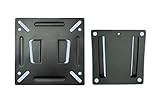
- NEW MODEL: The Mount Tatal Weight 0.52 lbs.
- NEW MODEL: Heavy Duty STEEL Construction.( AB 1.4mm)
Tilt Mount
A tilt mount allows you to simply tilt the TV up and down to minimize glare and achieve the best viewing angle from your position.

- Materials: Steel
- Finish: Black
Articulating Mount or Full Motion Mount
Articulating mounts are often referred to as “full-motion” mounts. These have the ability to pan, tilt, swivel, and articulate or extend out. This would allow for the viewing of the television from various angles or locations in the RV, for instance.
Pro Tip: If you choose an adjustable mount, try to find one that’s lockable to ensure it stays put while driving. This is key to securing a TV mount when your RV is in motion. Otherwise, you’ll likely need to use something like using a bungee cord to secure it for travel. A lockable mount is sleeker and simpler.
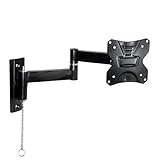
- Keep your TV SAFELY LOCKED IN PLACE while your VEHICLE IS IN MOTION.
- EZ PULL-CHAIN LOCK + release mechanism. No messing with knobs, gears, straps, or ties.
Find Your Mounting Location
Use your stud finder, infrared thermometer, or another method to locate a secure place on your RV wall in the room where you want the TV to be located.
It’s very important to use at least one stud because RV walls aren’t particularly robust. You don’t want to risk the television falling off the wall during travel due to the vibrations loosening it from an insecure position.
When choosing the location for your mount, remember that you’ll need access to either 12V or 120V power (depending on how you intend to power your TV).
Finally, be sure you have a path for the coaxial cable for the antenna, whether it’s an existing roof-mounted antenna or a wall-mounted one you’re adding.
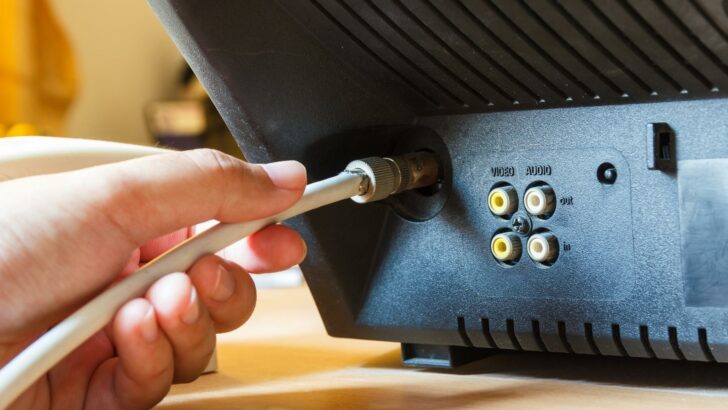
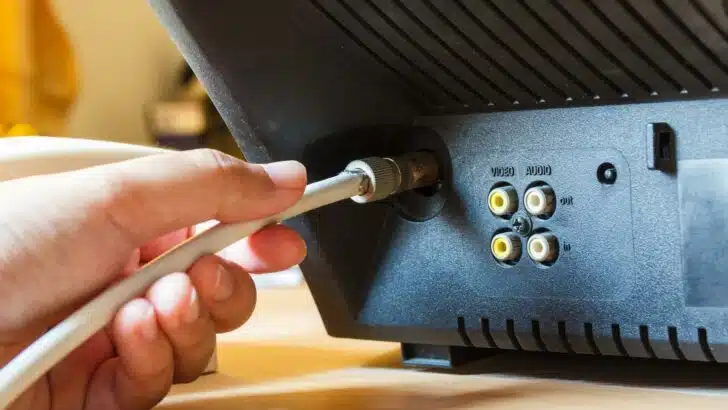
When choosing the location for mounting a TV in an RV, be sure to take note of where you’ll be routing your coaxial and power cords.
Attach the TV Mount to the Wall
Attach the mount to the wall according to the directions that come with your TV mount.
Attach the TV to the Mount
Carefully attach your TV to the wall mount you’ve just secured to your RV wall.
Run the Cable and Power
Run the cable and the power to the appropriate outlets, then power up the TV!
Remember to lock or secure your mounted television prior to taking off on the road. Add securing the TV to your pre-flight checklist.
Geek Out with Us Every Week
Join our newsletter to learn about all things RV-related. Every week we offer free tips, tricks, product reviews, and more to our online community of RVers. So, whether this is your first time on the road or you’re a seasoned expert, we’d love for you to geek out with us!
Gay Travel Enthusiast (Jason)
Saturday 7th of October 2023
I think it varies from camper to camper. I like to watch TV while I camp. Particularly at night while in bed.
Raymond McDonald
Friday 7th of October 2022
Good article as mounting a TV in an RV to make it accessible and functional can be a challenge. I have pondered this for some time now trying to find the most secure location. I have decided to do a pop up behind the couch or possibly out of a desk cabinet. I like the idea of the pop up because the TV while traveling will be low and secure. It will also not be seen until you want to see it with the pop up feature.