


RV wiring has traditionally been installed in a similar manner to electrical wiring in a house. In recent years, however, multiplex wiring systems for RV use have become more common. RV multiplex systems make the wiring throughout the RV more like that of a computer network which can have some real benefits.
But what, exactly, is an RV multiplex system? How does it work? And what are the benefits of multiplex wiring systems for RV use?
In this post, we hope to sort all of that out, so let’s get to it!
How Are Multiplex Wiring Systems for RVs Different from Traditional RV Wiring?
As we noted at the top of the post, RVs have typically been wired in a similar fashion to how a house is generally wired.
How Traditional RV Wiring Works
This means that separate wires are run from the source of power, through fuses or a breaker, to a switch, and then on to a fixture or appliance. With this type of wiring, each switch controls a specific device or string of devices (like several lights or outlets in the same area or on the same wall).
However, changing the configuration of switches/wiring/appliances requires pulling old wires and/or running new ones. This is something that’s particularly challenging in an RV environment.
How Multiplex Wiring Systems for RVs Work
Again, multiplex wiring is more like a computer network which means that power is provided to a common distribution center controlled by signals sent from switch/control panels located throughout the RV.
The switches are often connected to the distribution center using standard CAT5 network wiring or, sometimes, wireless.
In an RV multiplex system, the control panel can be physical buttons, or it can be a digital touchscreen display panel.
With a panel that uses a touch screen, the configuration or controls at any one location can easily be changed. But even on systems using physical buttons, you can re-program them to control something else if desired (though that may require relabeling the button).
The RV industry has made the RV-CAN network protocol standard in recent years. Typically denotes as “RV-C”, this type of network makes it possible for components throughout the RV to communicate with one another.
“CAN” (short for Controlled Area Network) is a technology that’s also used in automobiles and trucks.


In an RV multiplex system, the control panel can be physical buttons, or it can be a touchscreen display panel.
What Are the Benefits of Multiplex Wiring Systems for RVs?
Multiplex wiring systems generally offer a number of benefits in RV applications. Among them are the following:
Fewer Circuits Needed
Multiplex wiring reduces the number of circuits needed to wire the RV. This saves weight, reduces the size and complexity of the wiring bundles, and makes installation and maintenance simpler.
Smaller Gauge Wiring
Smaller gauge control wires can be used, which also means lower cost and less weight.
Easy Expandability
Expandability is much easier, so adding functions is possible without a major overall. For example, you could install a multiplex-enabled device with its features and controls available on existing control panels or displays without extensive additional wiring.
Easy Installation
Installation is simple for the RV manufacturer using a standardized harness configuration.
System Intercommunication
Multiplex systems allow increased intercommunication between systems, which enables more centralized monitoring and control.
Increased Automation
The centralized nature of the control in a multiplex wiring system also allows for increased amounts of automation. This can be as simple as the single-push operation of things like light controllers.
For instance, you could set the system to allow you to set lighting “scenes” so you could bring up “Movie Mode”, for example, where powered window shades are lowered and “mood” lighting is set to optimize watching a movie.
Or you could enable voice-activated control for use with hubs like Alexa, Google Nest, or Apple HomePod.
For example, you could say something like, “Alexa, turn on the kitchen lights” or “Alexa, turn on the water pump” (handy if your hands are wet!).


With multiplex systems that allow voice activation control you could tell Alexa to turn water pumps, water heaters, lights, and other electronic appliances and devices on and off using only your voice to control these systems.
RV manufacturers can also include app-based control systems, allowing you to use your smartphone/tablet to see system settings and statuses, or to control functions like lights, blinds, HVAC, etc., even when you’re not onboard the RV!
Who Makes Multiplex Wiring Systems for RVs?
While there are a number of companies getting involved in multiplex wiring & control systems for the RV industry, the following are some of the most common options:
Dometic Interact System
Dometic Interact, Dometic’s multiplex solution, allows the user to control and monitor all electronic devices throughout the RV with a single touch.
The system allows you to control lighting, your HVAC system, your water heater & water pump, and awnings. You can also monitor the status of your batteries, inverter, holding tanks, and LP gas from several locations in the RV or from the mobile app while you’re away from the RV.
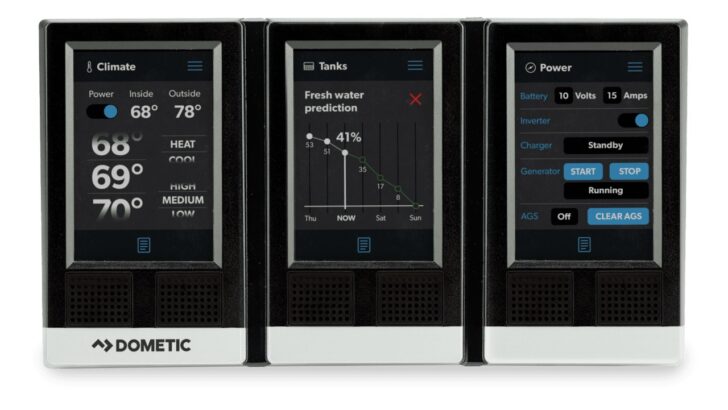
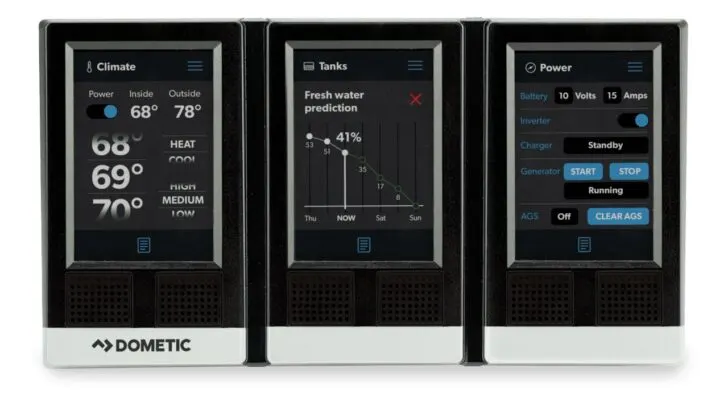
Dometic’s multiplex system allows you to control a variety of systems throughout the RV from touch panels in the RV or remotely from an app on your smartphone or tablet.
Silverleaf Electronics
Silverleaf’s HMS (House Monitoring Systems) line of products are commonly found in Newmar motorhomes. Various sizes of color touchscreen panels can be used throughout the RV to provide access to lighting, shades, awning, tank monitoring, power and other controls.
Offering comprehensive RV-C support, a Silverleaf multiplex system can integrate with many other onboard systems, including (but not limited to) major brands of inverters, HVAC systems, tank monitors, slide-out controls, awnings, and more.
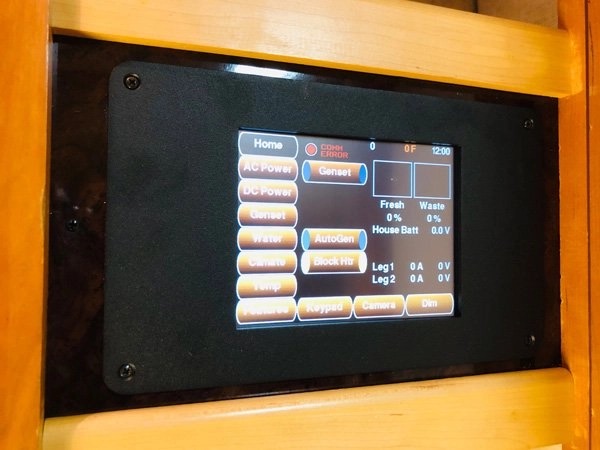
A Silverleaf HMS system control panel installed in an RV.
The interface on the touchscreen panels can be customized for day/night auto-dimming scheduling and/or custom color palettes, allowing the operation experience to be fully customized to match the RV brand and owner’s needs.
In addition to multiplex systems, Silverleaf also manufactures digital dashboards (to replace standard analog gauges) that provide enhanced visibility into vehicle performance and allow for a wide range of custom displays.
Intellitec Road Commander
Intellitec’s programmable multiplex system is known as “Road Commander“. The system offers various modules to control devices and appliances throughout the RV.
Road Commander has an HVAC module that allows control of heating, ventilation, and air conditioning. The system is operated via touchscreens or via Bluetooth on your smartphone or tablet.
If you have more than one HVAC zone, they can either be linked or controlled independently.
The Road Commander Low Current I/O module controls low current loads within the RV, such as interior and exterior lighting.
Road Commander’s High Current Module operates high current loads for such actions as extending/retracting slide-outs or for turning water pumps and water heaters on/off.
There’s also a module for starting and stopping your RV’s generator.
Firefly Integrations (Firefly System & VegaTouch)
The Firefly multiplex wiring system offers switch panels for real-time system monitoring using Vegatouch color touch panels.
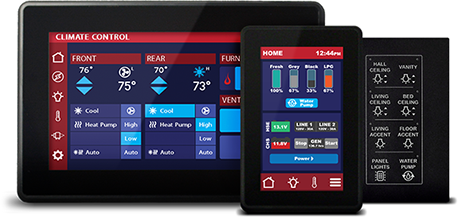
Firefly Integrations offers its RV multiplex control panels in several sizes and types.
These eliminate the need to install a variety of monitors, displays, and switches by combining them into a single switch panel.
The Vegatouch screens allow for the full control and monitoring of an RV’s lighting, HVAC system, awnings, slides, holding tanks, leveling system, water heater & water pump, as well as generator and other customized controls.
Spyder Controls
Spyder Controls designs premium custom electronic control systems for the RV industry and more.
Their multiplex electrical systems are designed for use in the RV, marine, speciality vehicle and heavy equipment industries.
Spyder Controls’ systems use touchscreens and keypad interfaces to sense and control modules, panels, power distribution systems, and other sensor technologies.
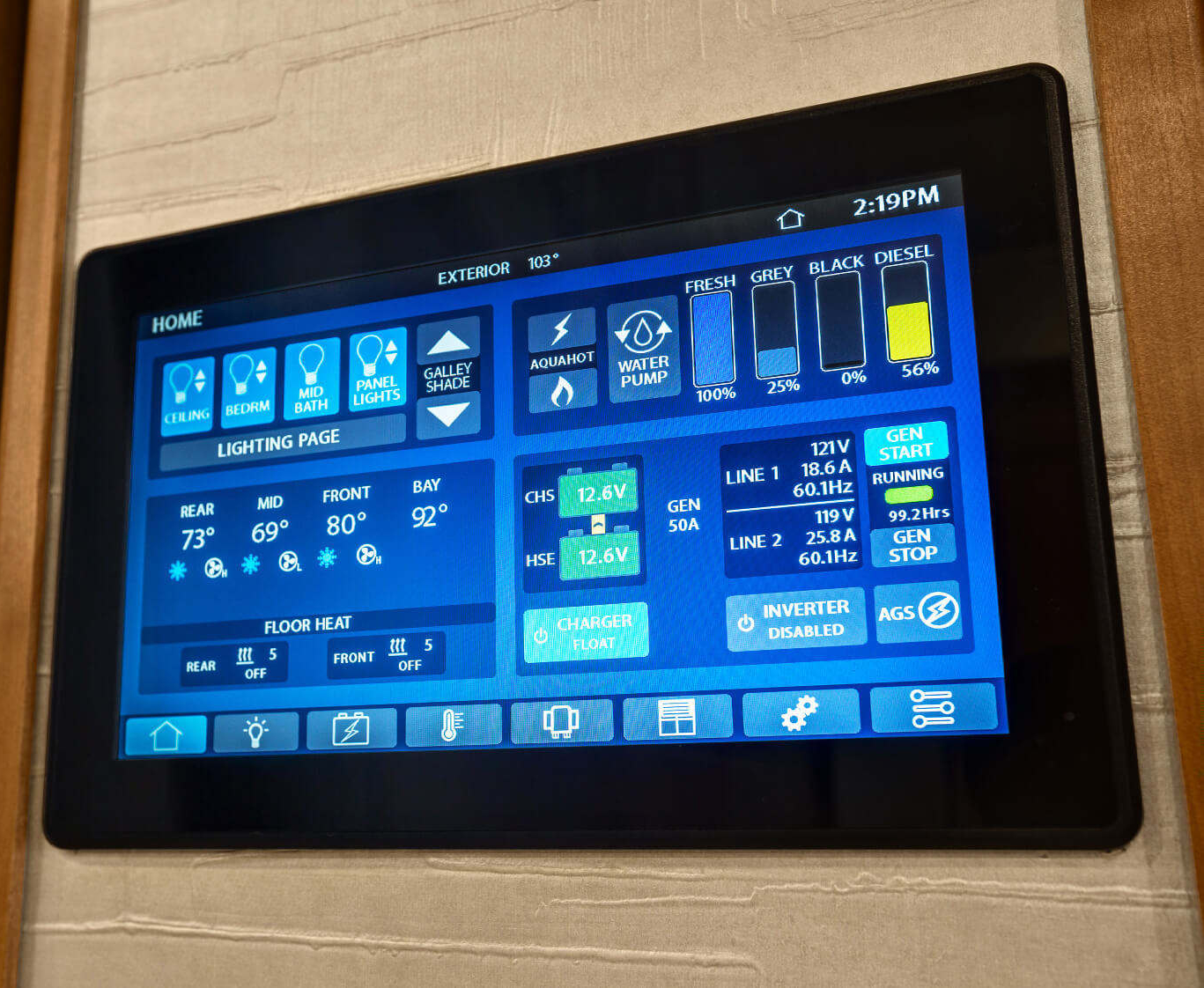
An example of a full-featured Spyder Control Systems touchscreen panel, shown here in a Tiffin motorhome.
Does Your RV Use a Multiplex Wiring System?
If you have experience with multiplex wiring systems in the RV landscape, we’d love to hear from you! Drop us a comment and tell us about your experience!
And if you’re interested in learning more about your RV’s electrical system and wiring, check out our article: RV Wiring For Dummies: Don’t Be Shocked By What You Don’t Know.
Free RVing Tips, Tricks, Reviews, Giveaways & More
Subscribe to our daily newsletter! We’ve been full-time RVers for 20 years (!) and share everything we’ve learned about RVing in our daily blog posts. Join our online community to receive a wealth of great RVing knowledge delivered right to your inbox.
Whether this is your first time on the road or you’re a seasoned full-timer, you’ll love the wide range of RVing topics we cover. Don’t miss a single article or any of our famous RV gear Giveaways — Subscribe today!
RonP
Friday 12th of January 2024
Great article. A block diagram of a typical system would be nice to visual the system.
Steve Mullins
Sunday 15th of January 2023
Thanks for the article. As you noted, multiplex systems don’t always come with a touch screen. Ours came with touchpads and push buttons to turn on and off things but it was still a multiplex system designed by Spyder Controls. We have a 2106 Tiffin Open Road and recently had two separate issues with our multiplex system. We had both fixed while in Red Bay Alabama, and learned so much about our system and it’s networking that we solved a third issue ourselves by tracking down a loose network wire for one of our panels.
Randall
Friday 13th of January 2023
Great article. Did you miss Silverleaf (https://silverleafelectronics.com/). I think it's used by Newmar.
TheRVgeeks
Friday 13th of January 2023
Hi @Randall... thanks for catching that. As we mentioned to @Kitesquid below, somehow the Silverleaf section got hidden/deleted before publishing. We've restored it, so it's there now.
Bruce H.
Friday 13th of January 2023
I had my own hi-tech electronics business for 40 years (design, install, service). I got into electronics as a hobby when I was a kid. My houses have home-control systems since the early 90's so I am fairly versed in this stuff.
So all this stuff is neat and cool... while it works....
We buy an RV and drive it all over and to places that are hundreds or thousands of miles from where we bought it, and something breaks down. Unless you understand all this stuff, who is going to fix it? And since you must generally get replacement parts from one source, the cost is huge (have you priced the cost of replacement electronic modules in your car?).
Worse yet, this type of technology tends to become "unsupported" quickly. Which means now you need to install a complete new system because one part, maybe just a switch is broken and is no longer available (NLA).
This stuff is fine for those with the million dollar coaches who stay at places that require them to buy a new coach every 10 years.
Myself, I'll stick with the conventional wiring in my 1977 classic GMC motorhome. BTW, I have added lots of hi-tech upgrades to it, but I understand it and therefore I don't rely on others if something goes wrong.
Just my 2 cents.
TheRVgeeks
Friday 13th of January 2023
It is true, Bruce... the more tech there is, the more there is to break! LOL! Though, as counterpoint, a lot of the systems do include more diagnostic information than you'll get from just a circuit breaker, wires, and a switch! But we hear you!
John S.
Friday 13th of January 2023
"So all this stuff is neat and cool… while it works…."
Yes! How true.
"Worse yet, this type of technology tends to become “unsupported” quickly. Which means now you need to install a complete new system because one part, maybe just a switch is broken and is no longer available (NLA)."
So very, very true. This is my experience.
Kitesquid
Friday 13th of January 2023
It looks like you forgot to mention Silverleaf and KBI, both are standard equipment on most models from Newmar.
Nancy Jacobs
Saturday 23rd of March 2024
@TheRVgeeks, We just bought a 2019 Pleasure-Way Lexor TS. I’m handicapped and have trouble reaching the Spyder touch screen control panel. Is there a downloadable app that will allow me to operate the control panel from my IPhone? Thanks! Nancy
TheRVgeeks
Friday 13th of January 2023
Hey @Kitesquid... thanks for catching that. Somehow the Silverleaf section got hidden/deleted before publishing. We just restored it... but KIB Electronics has virtually NO information publicly available (we looked and looked and looked), so we couldn't do the proper research to include them (we don't like using second hand information and like to go right to the source). If, by chance, you know of a website for them, please share! Thanks!