
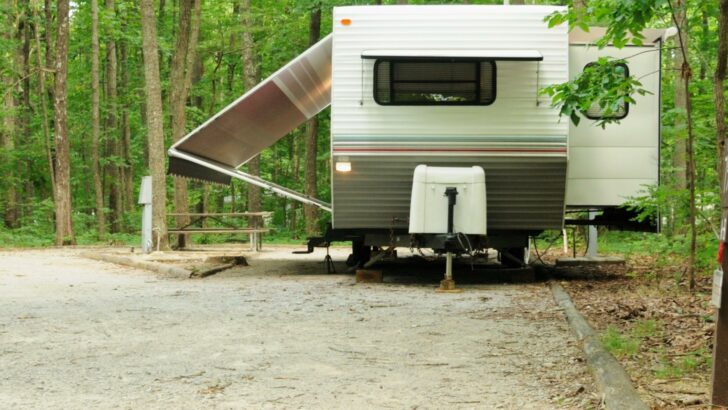

As we roll along as RVers, there are a number of things we learn that we didn’t know when we first set out. Little things that may seem inconsequential either turn out to be – well – just that. Or, they can turn out to be pretty darned important. Such is the case for RV jack pads.
The use of RV jack pads may seem like a minor consideration to RVers who haven’t yet experienced issues related to NOT having RV jack pads – and that’s understandable. In today’s post, we hope to share some information with newer RVers that might prevent them from having to learn the hard way.
RV jack pads? Let’s check them out, and see where they fall on our priority list – and yours.
What Are RV Jack Pads?
RV jack pads help to stabilize RVs and to prevent the rig’s jacks from sinking into the ground. But, in reality, RV jack pads are multi-taskers. They serve to accomplish a number of tasks with one product.
Provide Extra Lift For Very Uneven Sites
When you arrive at a campsite, there’s no telling what you’re going to find. Hopefully, you’ve read reviews from campers who’ve already experienced the campground so you have a general idea of what to expect, but every campsite is different, campsites can change, and every RV is different.
If you arrive at a campground where it’s tough to level your rig, RV jack pads can be very important because the extra lift they provide can be exactly what you need to not only stabilize your rig but also to level it.
Help to Stabilize the RV
Have you ever been in an RV when someone else is walking around and you start to feel seasick? It’s a nasty feeling, and your jacks are there to help with that, but sometimes the jacks alone aren’t enough. Either way, RV jack pads help to stabilize the rig so that everyone inside is a little more comfortable (as opposed to nauseous).
Distribute RV Weight Over Larger Area
RV jack pads help to distribute the weight of the RV over a larger area than that which is covered by the jacks alone.
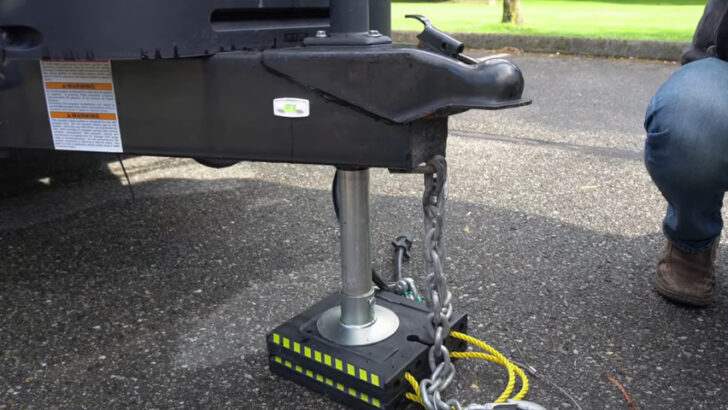
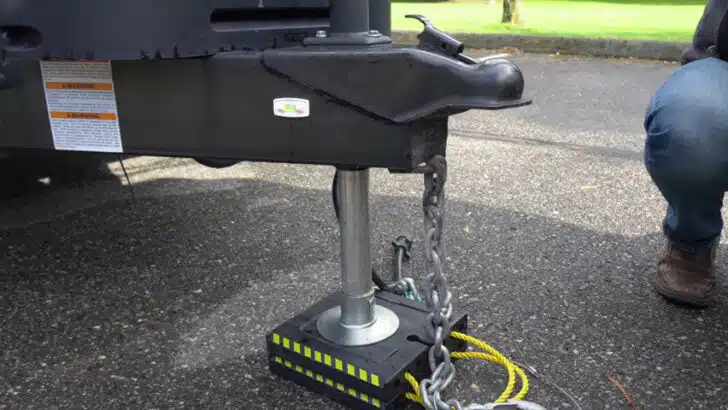
Good RV jack pads or Utility Blocks can not only level your RV but can also spread the weight of the jack over a wider surface, protecting the surface beneath it.
This is always helpful, but can sometimes be critical for keeping an RV from sinking into the ground when it’s standing on jacks alone. (And this is not an unusual occurrence. Jack pads are worth their weight in gold just from this perspective alone.)
Try camping on the beach and putting your jacks down in sand without a jack pad beneath them, for example. Or on soft dirt (especially in the rain, where dirt has now become mud), or even in snow. Or on someone’s lawn. You get the picture. If this was all a good RV jack pad did, they’d be worth having.
Protect the Surface Under Jacks
Depending on where your RV is parked, how much it weighs, and weather conditions, protecting the surface under the jacks can be very important. This is not only true at campsites but in other locations as well.
Suppose, for example, you’re visiting friends and you’re parked in their driveway on a hot, sunny summer day. Your jacks, when used alone, can easily sink into the surface of the driveway – or any other surface on the property. But with RV jack pads beneath them, the weight of your rig won’t likely impact the surface on which it stands.
Barrier Between Tires & Surface When Storing
RV jack pads can be very important in acting as a barrier between your rig’s tires and the surface on which the rig is stored.
If you’re parking your RV on grass, bare ground, or asphalt, park it with the tires on top of a set of jack pads to act as a barrier to ensure that moisture (grass/bare ground) and chemicals (asphalt) don’t damage and prematurely age the rubber of your tires.
Do All RVs Need Jack Pads?
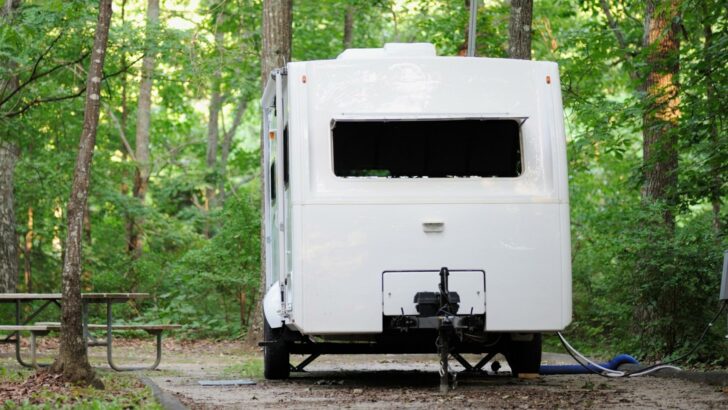
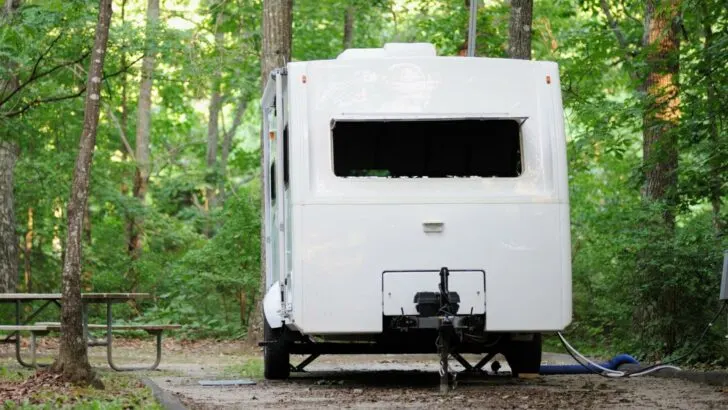
Not all RVs use jacks, but those that do can surely benefit from a good set of RV jack pads.
Not all RVs need jack pads, but only because not all RVs have jacks!
Many Class B RVs, for example, don’t come with jacks, and many owners of camper vans don’t mind.
With that said, however, we’ve known Class B owners to purchase jacks to use with their small RVs for the purpose of stabilizing the rig when someone is walking in it. (See nausea note above.)
Even RVs without jacks can benefit from jack pads, though, if only to use them to level the rig or protect their tires while in storage.
So, if you don’t use jacks, then you don’t need jack pads, but you may find them helpful in certain situations.
Are All RV Jack Pads Basically Alike?
Nope. There are jack pads and then there are JACK PADS.
Some jack pads are significantly stronger and beefier than others and are designed to hold the weight of your RV-on-jacks for many years to come, no matter the weather over time. But we’ve seen jack pads crack or cave/bend under the pressure of the RV, or lose their strength after being exposed to hot or cold weather extremes. None of those are jack pads we’d want to have.
Below we’ll highlight three of the best jack pads we know of for all types of RVs.
What Are the 3 Best RV Jack Pads to Consider for Your RV?
With quality and durability in mind, these are, in our opinion, the three best choices for RV jack pads available on the market today:
Utility Blocks
You may have seen us gush about Utility Blocks in previous posts like our first one back in 2013 entitled The Best RV Leveling Blocks (Jack Pads), or the more recent Do You Need RV Leveling Blocks from 2021.
In the first article, we gushed because we were so impressed with our Utility Blocks jack pads. We even made a video on them at the time.
The second time we featured Utility Blocks was in a post we wrote about leveling blocks. So, this tells you a couple of things.
First of all, we’ve been using our Utility Blocks for a long time – and we’re still using them. Yes, the same set.
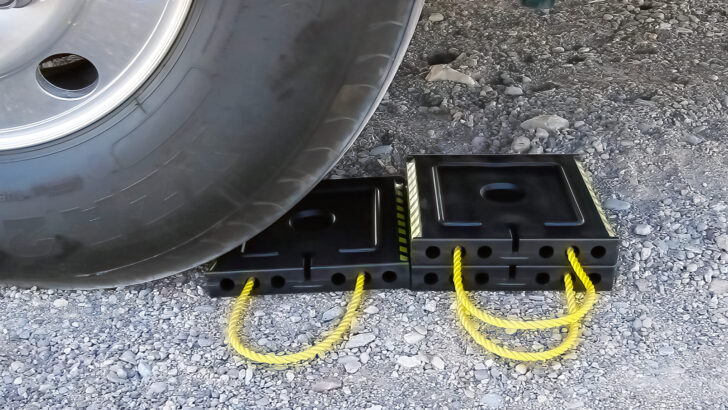
Utility blocks have some unique features: beveled ramp edges for easily driving onto them, interlocking key design to keep them in place when stacked, and convenient rope handles for placing them.
Secondly, our experience tells you that Utility Blocks are capable of pulling double duty. Not only do they serve as excellent jack pads fulfilling all of the needs we’ve noted in today’s post, but they’ve also served as levelers on many occasions. Anything we’ve asked these Utility Blocks to do, they’ve done with aplomb.
Utility Block jack pads are lightweight, compact, and almost indestructible. And while they’re more expensive than some of the plastic blocks you see in camping stores and on Amazon, they’re well worth the money because they’ll last (apparently forever, if our experience is any indication), and they cost far less than many of the high-end jack pads you see on the market, without sacrificing quality in any form.
We love these jack pads and (apparently!) can’t gush about them enough.

SnapPads
The best way we can explain SnapPads is to say that they’re like shoes for your RV jacks.
SnapPads are permanently attached to the feet of your jacks. They’re American-made from recycled tires (which we appreciate) and, once installed, they remain on your jacks, only requiring that the jacks be deployed when you arrive at your destination.
SnapPads are available for motorhomes, travel trailers, 5th wheels, and truck campers. SnapPads don’t work on all RV jacks, though. You can consult the SnapPads “cheat sheet” to see if this product will work for your rig.
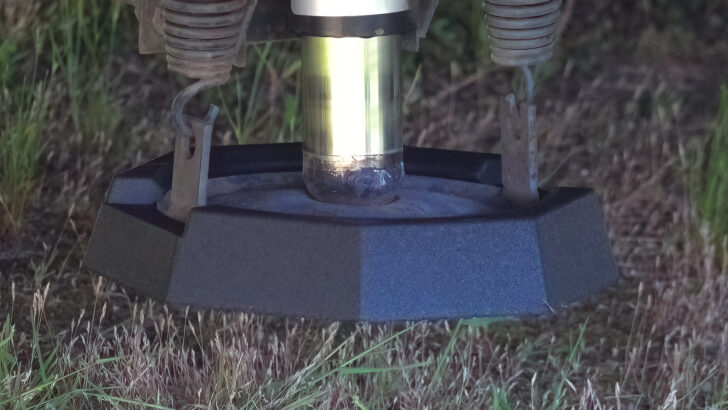
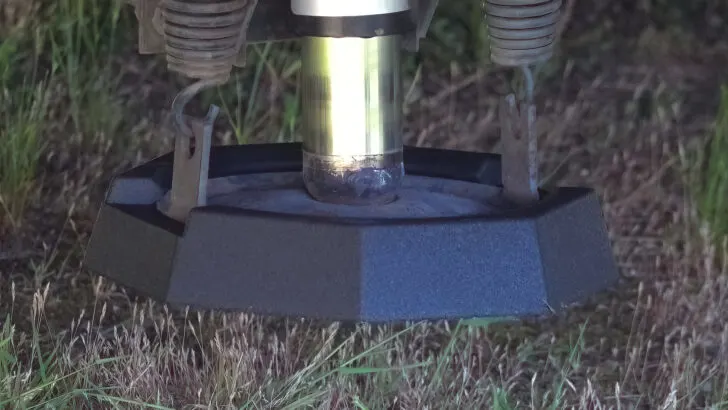
SnapPads are aptly named… they snap into place on your RV’s leveling jack foot, staying there when extended/retracted.
We have friends who use SnapPads and love them (they gush about SnapPads the way we gush about Utility Blocks). The only real downside we can see to SnapPads, however, is the fact that once attached, they really can’t be removed. They can be pried off, but not only would this void their two-year warranty, but it could also damage your jacks.
So, if you’re going to opt to install SnapPads as your RV jack pads, research them carefully and make sure they’re what you want before installing them. Once they’re on – they’re on.
SnapPads are a high-quality product, a well-thought-out innovation, and likely the only permanently installed RV jack pads on the market.
Prior to purchasing SnapPads, be sure to take accurate measurements and order the SnapPads that are the proper dimensions for your RV (and, of course, order the number of SnapPads to correspond with the number of jacks you have). Once you’re ready to order, save 10% on your purchase using the coupon code:


One side note… the only reason we don’t have SnapPads on our Mountain Aire is that we have very uncommon landing gear on our hydraulic jacks, so they don’t make a size/shape that will fit our rig.
BigFoot Pads
BigFoot Outrigger pads for RVs are made of composite plastic and are, according to reviewers, both compact and durable. One Amazon reviewer in particular notes that he uses these RV jack pads under his 40-foot diesel pusher. We have a set of the 15” square pads (which aren’t all that light OR cheap) and use them whenever we’re on especially soft ground. The added size of these pads dramatically increases the surface area the weight of our RV is distributed across, minimizing/eliminating the potential for us to sink into the ground.
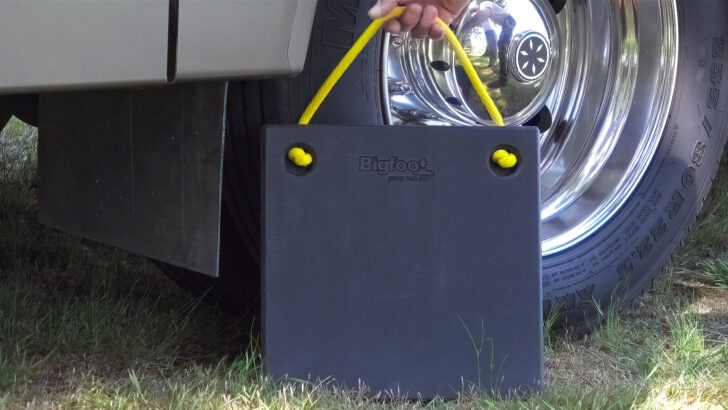
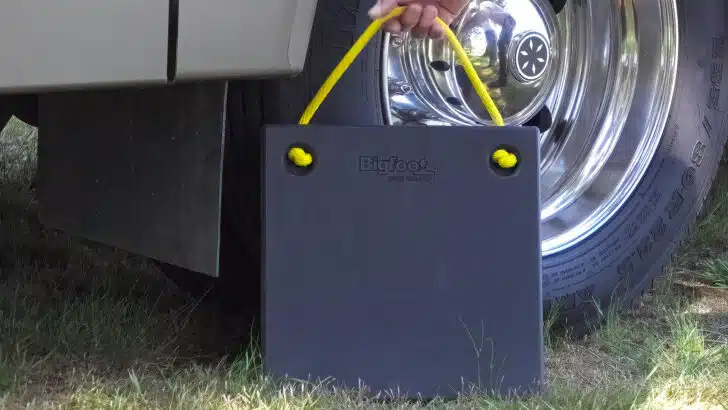
Bigfoot jack pads are exactly that… BIG!
BigFoot Outriggers are rated to 45,000 pounds and are an inch thick. The set below contains four Outrigger pads that are 12”x12”x1”. Be aware that BigFoot carries pads that are 15”x15”x1” as well as others, so check their website to locate the right set of Outriggers for your particular RV.
We’ve added a set of extra-large BigFoot pads to our arsenal for those times when we camp on particularly soft surfaces. The 15″ square surface area keeps us from sinking into all but the softest ground.

- MADE IN USA
- Custom Composite Plastic
What Are Your Favorite RV Jack Pads and Why?
Do you have a favorite set of RV jack pads that you carry? Feel free to share your experiences with RV jack pads in the comments section below. We’d love to hear from you!
Geek Out With Us Every Week
Join our newsletter to learn about all things RV-related. Every week we offer free tips, tricks, product reviews, and more to our online community of RVers. So, whether this is your first time on the road or you’re a seasoned expert, we’d love for you to geek out with us!
Max Shaver Jr
Monday 17th of January 2022
For the DIY RVer, get a 4'X5' 1/2" or 3/4" Rubber Horse Stall Pad at Tractor Supply, or you favorite farm supply store. Lay out 12"12" squares and cut With a sharp utility knife, using extreme caution. You can make them any size you want, but I have found 12x12 to be sufficient for our 17 Thor Challenger 37TB, and easy to store. From this pad you can make enough for you, and several Camping friends for around $35
Lisa
Thursday 14th of December 2023
@Max Shaver Jr, thanks for that great idea! I’d wanna be able to put the rope handles on them and I don’t know how to do that.
TheRVgeeks
Tuesday 18th of January 2022
Good tip, Max. Thanks!
Dr. Michael
Monday 17th of January 2022
I could not find a jack pad for our 60,000 pound class A, so I made them. I cut 16 inch sections of treated 2 x 12 and added a large screw eye to one end.
rag_ftw
Sunday 16th of January 2022
Snap Pads won't work on my 38DS04 Travel Supreme with Equalizer jacks. The front pads will make contact with the wheels when turning with the steering wheel at full lock! Check for your clearance prior to purchase of Snap Pads.
TheRVgeeks
Tuesday 18th of January 2022
Sorry to hear that... but thanks for sharing your experience. Good to know (and check) before buying!
Ralph Alder
Sunday 16th of January 2022
SNAPPADS...I LOVE 'EM. I was initially put off the SnapPads by the price...and that I have 10" disks and 12" disks and I couldn't find a package that would work...but mostly the price. Then one day it hit me...at 78 YO I'm getting too old to crawl around on all fours positioning various rubber and wood blocks under our motorhome. Hot or rainy afternoon setups were the worst. I realized that getting the blocks out, positioning and re-positioning blocks and take down takes 1/2hr easily. For my 78th birthday I plopped down the big bucks and ordered a set. BEST THING I EVER BOUGHT. There were a little tricky to install as I was on a gravel site and a hard surface is recommended. It is nice to know that they are very difficult to remove since that was my only worry, that they would fall off. I don't have to worry about forgetting to retrieve them either.
Now, I pull into a site, check under where the jacks will go to be sure there are no rocks, root or other objects...and lower jacks and level. Done. Period.
You guys should check again, they might make a set for your rig. You won't regret the purchase for a minute.
TheRVgeeks
Tuesday 18th of January 2022
Thanks for the input, Ralph. We know lots of people who love their SnapPads! We're in regular contact with them about a set that would fit our jacks... but ours are (1) quite large, (2) a hexagonal shape, and (3) no longer used, so there's not a huge impetus for them to make a mold. Might just have to buy a new RV, instead. ????????
Tim Howlett
Sunday 16th of January 2022
I purchased the Quality Plastics Utility Blocks soon after we purchased our Class A motorhome in spring of 2020. Very happy with these so far. I really like how durable they are as well as how they interlock for stacked use and storage. Also, the slightly “ramped” edges make a surprising difference in how easy they are to drive up onto.
TheRVgeeks
Tuesday 18th of January 2022
We're with you, Tim. We LOVE our Utility Blocks for all the same reasons!