
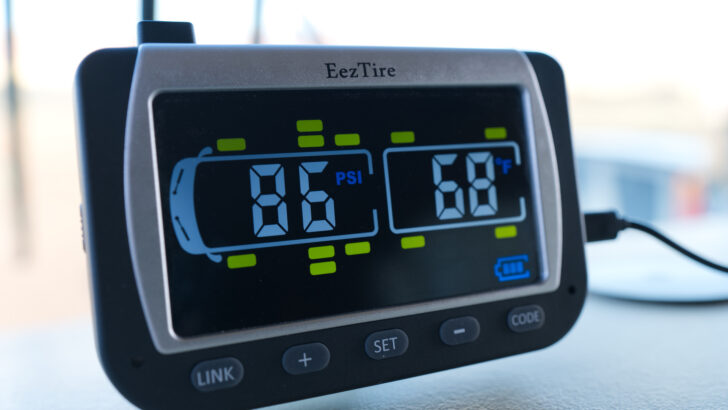
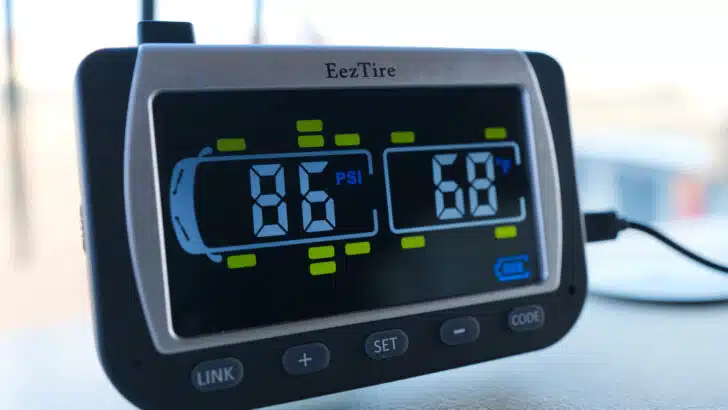
An RV TPMS (Tire Pressure Monitoring System) is a safety feature that not only protects you (and everyone riding in and around your RV while you’re on the road), but it also helps to keep your tires in tip-top condition, a goal near-and-dear to the hearts of RVers… for many reasons.
So, today’s post is dedicated to the ever-important RV TPMS – something every motorhome should – and can – have.
Let’s take a look at why this system is so important.
What is an RV TPMS?
The purpose of an RV tire pressure monitoring system is to track the pressures of all tires on the rig to make sure proper tire pressure is maintained as you travel.
Many factors can cause tires to lose air, including a change in ambient temperature, a slow leak, a fast leak caused by something the tire strikes in the road, or even just time and travel.
Using our rig as an example, we’re 43-feet long (without the car in tow!) and VERY heavy. If we’re rambling down the highway at 65 miles per hour and one of our RV’s tires blows out, we could find ourselves in a very precarious situation. Not only would we be in danger in this scenario, but so could anyone traveling near us on the road.
This is what makes an RV TPMS so critical.
Constant monitoring of tire pressure allows us to be alerted to any changes in the tire pressure of every tire on our rig as they happen.
How Does an RV Tire Pressure Monitor System Work?
A TPMS places a sensor at each of an RV’s tires, and the sensors allow the constant monitoring of each tire’s pressure.
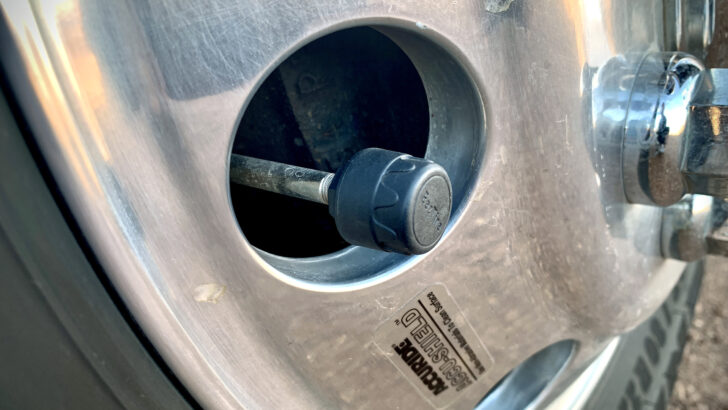
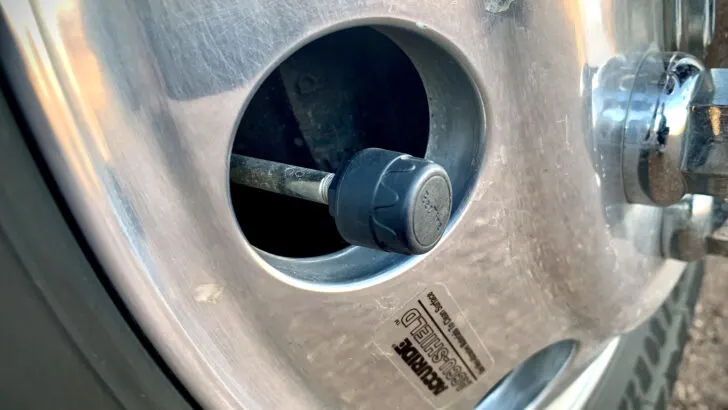
A TPMS sensor is placed on the valve stem of each tire to constantly monitor the condition of that tire.
As soon as the pressure in any one of the tires drops below the appropriate level, the driver is notified via the information on the TPMS console mounted on the dashboard of the rig.
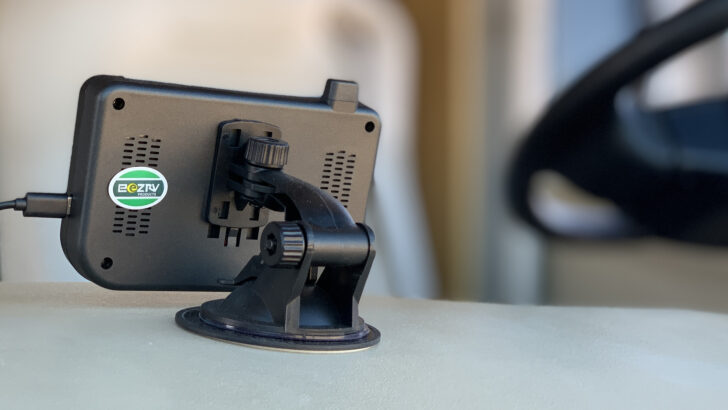
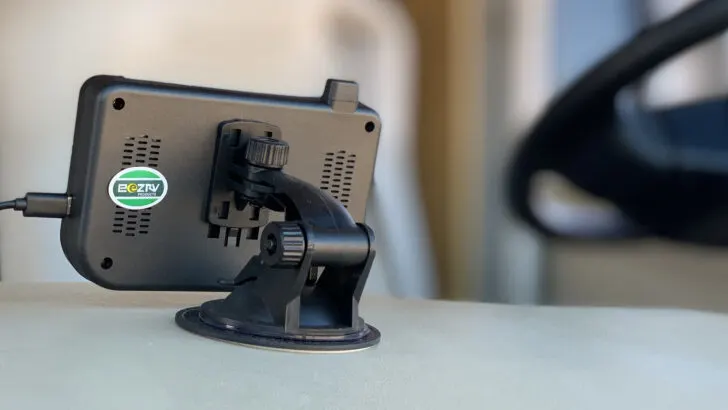
The monitor of our RV TPMS sits on the dashboard for easy reading while riding down the road.
Those are the basics of how a TPMS system works but, depending on the model, some offer a variety of additional features. Our system, for example, offers customizable high and low-pressure alerts and a high-temperature alert (each sensor is also monitoring the temperature of the air in the tire).
Why Do You Need an RV TPMS?
There are several important reasons to have an RV TPMS. The first and most important by far is safety.
Safety
A system that monitors your tires contributes to your safety, the safety of everyone in your RV, and the safety of everyone in the vicinity of your rig.
A TPMS system is a good tool for every vehicle, and even more so for RVs. Most motorhomes are large, long, tall, and very heavy. Some, like ours, have twice as many tires as the average vehicle on the road.

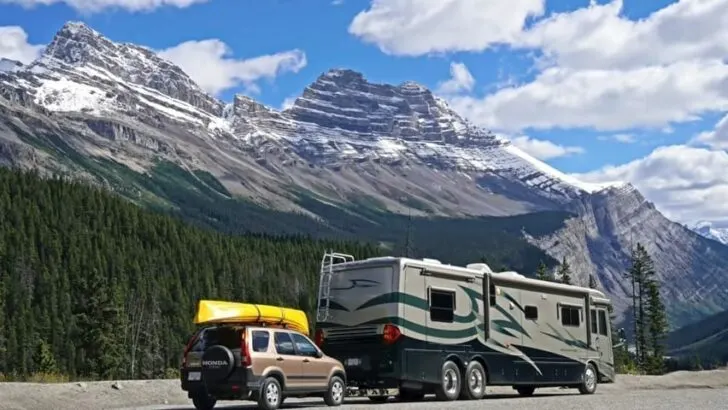
We ride down the road on 12 tires, and you can be sure we appreciate our tire pressure monitoring system as we do.
Our rig has eight tires and our toad has four more. So, we ride down the road on 12 tires. Our RV alone weighs over 18 tons, and we spend a lot of time on the road. At any given time, any one of those 12 tires could have an issue, and we want to be alerted as early as possible.
A blowout in any vehicle is dangerous. A blowout in a 43-foot motorhome towing an SUV while hurtling down the highway could very easily be catastrophic. We wouldn’t be without our RV TPMS, and the number one reason for that is safety.
An RV TPMS Extends Tire Life
Tires that are over-/under-inflated wear out more quickly than tires that are maintained at their recommended PSI. Overinflation leads the tire tread to wear more quickly at the center of the tire, while underinflation can cause the outer treads to wear prematurely. For this reason, a TPMS extends tire life, and with 12 (expensive!) tires to maintain, we’re all for that.
Environmentally Friendly
Under-inflated tires wear sooner and reduce fuel efficiency by increasing drag. This makes a TPMS an environmentally friendly system in a couple of ways.
First, there’s the fuel consumption issue, of course. Improperly inflated tires can increase the drag resisting the rotation of your wheels, causing your RV’s engine to have to work harder (i.e. burn more fuel) to roll down the road.
“Under-inflated tires can lower gas mileage by about 0.2% for every 1 psi drop in the average pressure of all tires.”
There’s also the matter of tire replacement. A worn tire requires replacement, and the more tires we replace, the more rubber, steel, nylon, silica, polyester, carbon black, petroleum, etc. we use (and dispose of)!

A TPMS has an economically and environmentally friendly impact by extending the lives of our tires.
Types of RV Tire Pressure Monitor Systems
There are two types of RV TPMS – direct and indirect. Let’s take a look at what distinguishes them from one another.
Direct RV TPMS
The most common form of TPMS, these types of systems add a sensor to each tire (either installed inside the tire by mounting it to the wheel/rim, or externally on the valve stem). The sensor is programmed to that tire position and then provides real-time data, alerting the driver if the tire’s pressure drops below the appropriate level.
Some direct TPMS units will also alert you to a slow leak in a tire as well as when a tire’s temperature rises above a certain point.
Indirect RV TPMS
Indirect tire pressure monitoring systems are less common. They work along with the antilock braking system of your RV or vehicle.
An indirect TPMS senses and monitors how fast the wheels are spinning. When one wheel spins at a different speed than the others, it generally indicates improper tire pressure in that tire. The driver is alerted to the discrepancy and can stop and tend to that tire.
With an indirect TPMS, the sensor must be recalibrated every time the tire pressure is changed.
Indirect TPMS units are factory installed only and are not available as aftermarket systems.
What to Look for in an RV TPMS
Here’s where we get into the details. RV tire pressure monitoring systems have a number of features that are important to assess when considering the purchase of a system for your rig.
Display
The type of display on a system you need to monitor while driving is an important consideration. If you can’t read the display in the sun, for example, the monitoring system is relatively useless whenever you’re driving in those conditions.
On the TPMS we have, the display is a feature we really appreciate because the screen is easily read even when we’re wearing our sunglasses.
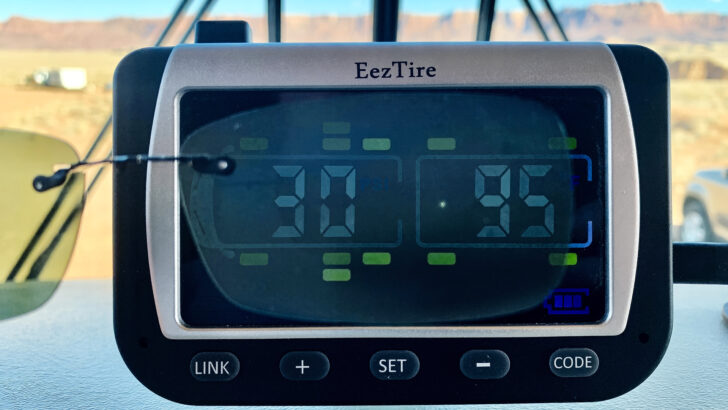
It’s important to us to be able to read the screen on the monitor of our TPMS while wearing our sunglasses.
While this may seem like an obvious feature of any TPMS, we can tell you that it isn’t. The TPMS we had prior to the one we have now was made such that when we wore our sunglasses (something we often need to do while driving the RV), neither of us could read the display.
We also appreciate that our system has a 4 ½” x 3” screen, which makes it that much easier to read. Hey – we’re no spring chickens here!
Seriously, it’s very important to have a TPMS with a high-quality display that’s easy to read.
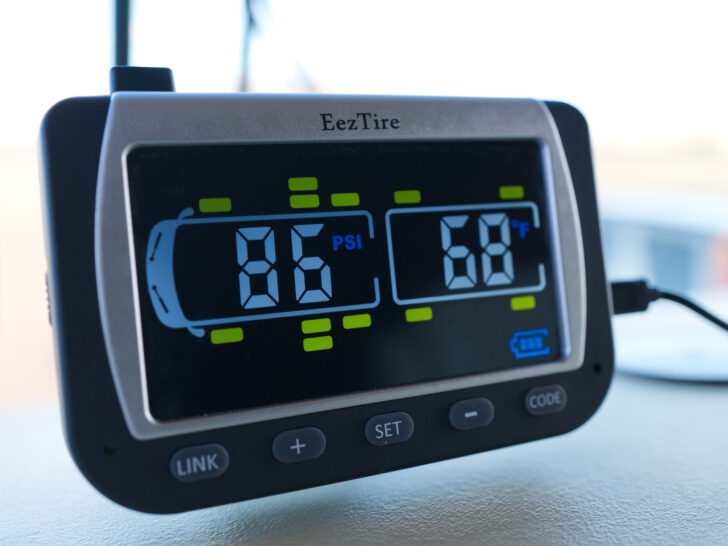
When shopping for a TPMS for your RV, be sure the monitor has a high-quality screen that’s large, bright, and easy to read at a glance.
Ease of Use & Installation
This is self-explanatory, but no one likes to have to spend hours trying to figure out how any system works. We want a system that’s easy-to-install and easy-to-use so that we can set it up, learn how to use it quickly, and carry on about our business.
So, when shopping for a TPMS, be sure to read reviews where you can often find comments from people who will often express how frustrating a system was to install or to learn.
You want a system you’ll install and walk away saying, “That was easy”, and one you’ll use almost without having to think about it.
Reliability
The reliability of any product is always important. But when you’re counting on a product to give you accurate information related to a safety item, you want to be darn sure that information is reliable.
We’ve heard complaints from others about wireless connectivity issues. If your TPMS only monitors the condition of your tires some of the time, then it’s not serving its intended purpose.
This is another reason why we love our current system. Our RV TPMS system includes a booster that we mounted to the wall in the back of our bedroom closet. With it, we’ve never had a drop-out in the years we’ve owned and used the system.
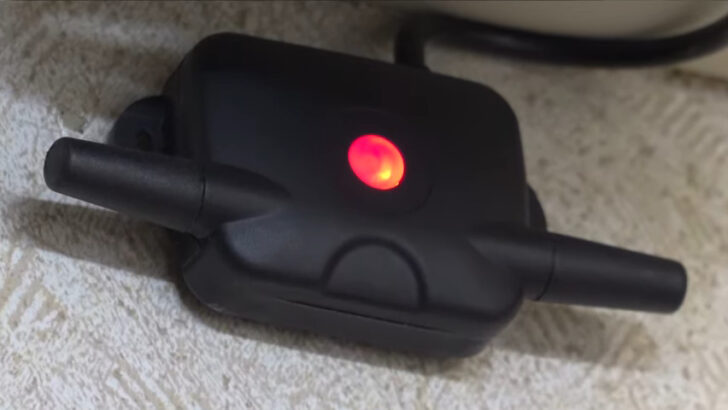
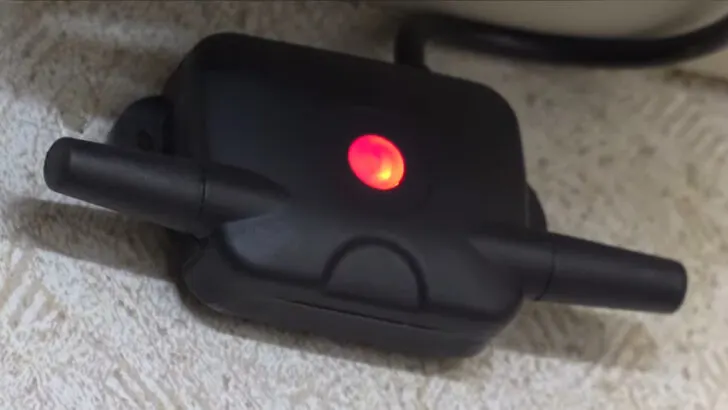
This booster sits in the back of our tech cabinet ensuring that we don’t experience any dropouts in the information the sensors of our TPMS deliver to our monitor.
That’s the kind of reliability we want in a system that monitors the pressures and temperature of our tires as we roll down the highway.
The reliability of how the system responds is crucial. The system must properly respond to changes in tire pressure and temperature, or it’s of no real use and could even present a danger if it’s giving inaccurate information.
Flexibility
One size does not fit all with a tire pressure monitoring system. The reason is that we’re all driving and towing different rigs. For example, we generally tow our Honda CR-V behind our rig. But let’s say we’re taking a road trip and leaving our toad behind.
Our TPMS allows us to separate the two different parts of our towing configuration. So, if we were to leave our toad behind, we can “drop” the CR-V from the system and monitor only the tires on our motorhome. Or, vice versa, we can take the monitor with us in the CR-V and “drop” the RV’s tires, so the system only monitors the car’s tires while out on a day trip.
This is perhaps an even more important feature for trailer/fifth wheel owners. They need to know that even if they’re not towing their RV, their TPMS will work on their truck.
Another important element of flexibility is whether or not you can buy as many sensors as you need, based on how many tires you have. We bought 12 sensors with our system (because we have 12 tires), but we could have purchased sensors for anywhere from 4 to 26 tires!
So, flexibility is an important feature to consider in a TPMS.
User-Replaceable Sensor Batteries
A system that allows you to replace the batteries is an important consideration when purchasing a TPMS.
Our previous TPMS didn’t have user-replaceable batteries, and as the batteries began to die, we started having an issue with individual tires not properly reporting. The cost of replacing the low-battery sensors was more than buying a whole new system, so that’s when we decided to see what improved technology we might be able to take advantage of with a new system.
Our current system, however, has a monitor with a built-in rechargeable internal lithium battery that lasts up to 60 hours on a single charge and comes with a common USB charging cord that can be connected to a USB port on our dash for easy charging. The 12 tire sensors each have replaceable batteries (size CR1632).
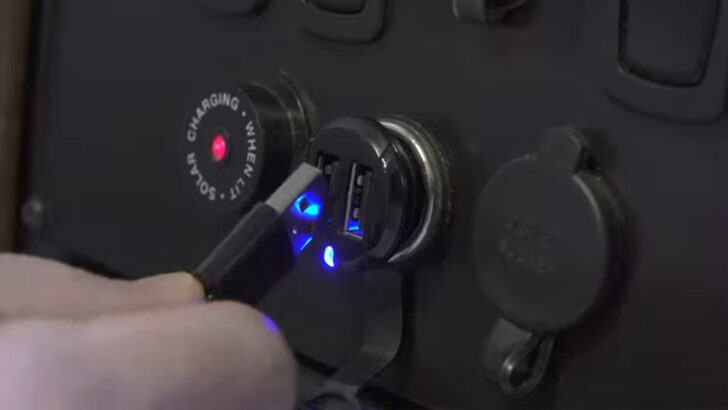
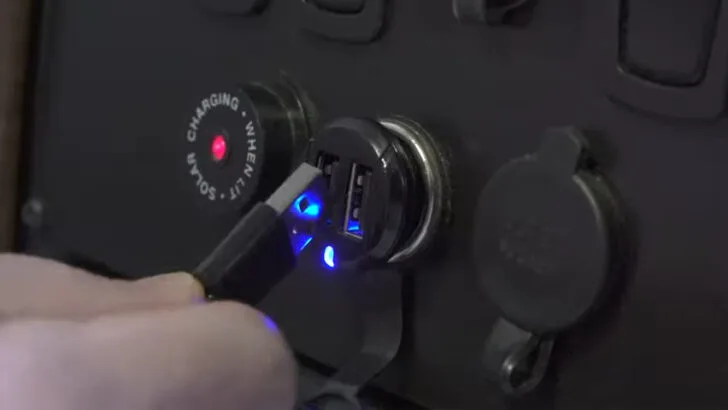
Our system allows for easy charging using a standard USB port on our dash.
If you’re looking at a system that doesn’t have user-replaceable batteries, you need to know the predicted life of the included batteries, and you also want to know whether the sensors can be sent back for replacement when they’re no longer sensing accurately due to low battery power. (Or perhaps replacements are offered at a discounted price.)
Cost/Budget
Budget is always a consideration when shopping for a product, and a tire pressure monitoring system is certainly no exception.
There are various systems out there at various costs. For our money, running 12 tires and tens of thousands of pounds of our home, office, vehicles, and possessions (and ourselves!) down the road, we shopped for quality.
But – we also had experience with our previous TPMS, and we didn’t love it. We really do love the one we have now because it’s so easy to use and so reliable. And with reliability being the bottom line, we can safely say that if we had to replace our current TPMS for some reason, we’d buy the same system.
As far as cost is concerned, we felt our current system was fairly priced for what we got. Again, we bought 12 sensors with our system which also came with the large, high-quality color monitor, signal booster, mount and mounting hardware, USB adapter (for a cigarette lighter port), cords, and well laid-out instructions. Our system also carries a three-year warranty which was important to us.
Understanding that budget is a consideration for everyone, we found the cost of our system to be competitive in the industry. We also are generally of the mind that we’d like a quality product up front, so that not only will it perform well for us, but we won’t have to replace it for a long time to come.
What Tire Pressure Monitor System Do We Use in our RV?
Our current system is the EezTire E618, an updated model (brighter, color screen) from the one we used in our video below. We’ve found it to be extremely reliable with features that make it one of the best, most cost-effective tire pressure monitoring systems out there.
EezTire is an industry leader with a good reputation for building high-quality RV TPMS since 2005.
The accuracy with which the system monitors pressure (up to 210 psi) and temperature gives us peace of mind. The system is motion-sensitive and monitors tire pressure and temperature at 6-second intervals… continuously.
We get visual and audio warning alarms immediately when tire pressure or temperature falls outside our safety parameters.
After 15 minutes of no motion being detected, the monitor goes into power-saving mode to save battery power.
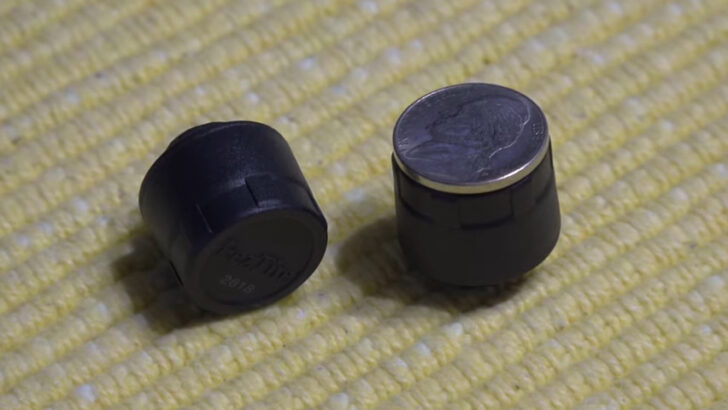
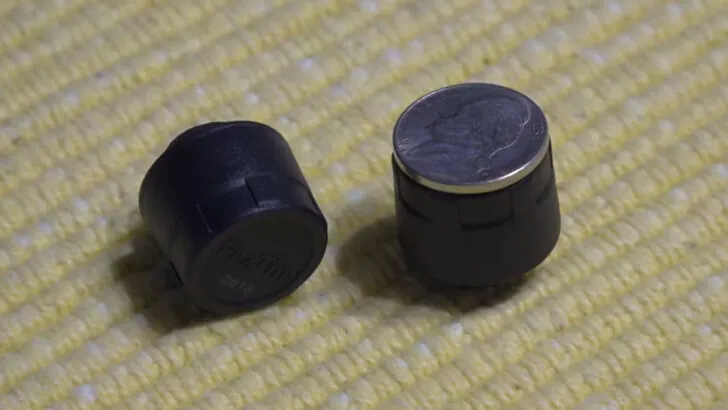
Here you see two of the twelve sensors of our TPMS. The sensors themselves are very small – about the size of a nickel, as shown in the photo.
We found it exceedingly easy to set up and program. With this system, you can simply walk around the RV with the monitor and all of the tire sensors, installing one on (and programming it to) each tire as you go. They offer your choice of anti-theft sensors (the smaller style we use) or flow-through sensors (or even different combinations of both sensors) to meet the needs of different tires.
Many people report liking the flow-through sensors, since you don’t need to remove the sensor to add/remove air from your tires. But since you are going to screw a cap onto the outer valve of the flow-through sensor… you always have SOMETHING you have to unscrew. And since the flow-through sensors are longer, larger, and a bit heavier, we prefer the anti-theft sensors.
The high- and low-pressure alerts and the high-temperature alerts are all customizable, another feature we love.
Our system has a booster that boosts the signal over distance and eliminates any electromagnetic interference challenges from the engine and/or other electronics. With our monitor on the dash at the front of the RV, the rear tires on our CR-V are easily 60 feet back, with a lot of metal, wiring, and electrical equipment in between. But we never have an issue with those tires dropping out of range.
We’re pretty heavy users as tires and tire monitoring systems go. We’re on the road full time, and we cover a lot of miles and some pretty tough terrain from time to time. We pose quite a challenge for a TPMS, and our current system has met the challenges we’ve thrown at it since we bought it in early 2019.
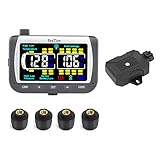
- REAL TIME/24x7 SAFETY & HIGH FUEL ECONOMY - EezTire TPMS system by EEZ RV Products is the industry leader in the RV TPMS market since 2005. It...
- ADVANCED TECHNOLOGY ALERT SYSTEM - the monitor is motion sensitive and monitors tire pressure and temperature on 6-second intervals continuously. It...

Back in 2019, six months after purchasing our EezTire TPMS, we made the following video to let our readers know how the system was working out for us. If you have any interest in seeing exactly how our system works, you’re welcome to check it out here:
Get an RV TPMS For Your Safety & Security
You can’t put a price on peace of mind, and you certainly can’t put a price on safety. An RV TPMS is a must-have to keep you safe as you’re rolling down the road on any number of tires that are impacted by any number of variables.
Geek Out with Us Every Week
Join our newsletter to learn about all things RV-related. Every week we offer free tips, tricks, product reviews, and more to our online community of RVers. So, whether this is your first time on the road or you’re a seasoned expert, we’d love for you to geek out with us!
Lisa Nunn
Friday 7th of January 2022
As newbies preparing to full-time, your information has been so helpful, and your website our go-to for answers. We have been ordering items, including this TPMS through your links as a small thank you. Keep up the great work!
TheRVgeeks
Friday 7th of January 2022
Aw, thanks so much, Lisa. We're glad our info has been helpful, and truly appreciate your support! Safe travels!!
Wells
Saturday 6th of November 2021
For a few years now, you fellows have been a very great help and I thank you! Now I need a TPMS. The EEZTire has two types of sensors. What are they and what are the advantages of each? Do both types have replaceable batteries?
TheRVgeeks
Sunday 7th of November 2021
Thanks so much for your kind words, and great question. We use EEZ's "anti-theft" sensors (although they're only actually anti-theft when you install the included lock nuts with them, which we don't bother with). They're very small, light and unobtrusive. The purpose of the "flow-through" sensors is to be able to add air, or check pressures, without removing them. But we don't have any reason to check air with a regular air gauge, since of course the TPMS itself allows us to check all tires right from the driver's seat. And it's such a rare thing to need to add air... and the anti-theft sensors are as easy to remove and re-install as an ordinary valve stem cap, so we don't see the need for quicker access to add air (and since the flow-through type have caps on them anyway, it saves ZERO time). The flow-through sensors are also heavier and longer, which is why EEZ specifies they should ONLY be used on rigid (not rubber) valve stems. The length and weight of them can and will flex rubber valve stems at speed. We think the flow-through sensors are a waste of time and would never use them. And we LOVE our regular sensors a lot! By the way, both types have replaceable batteries. Hope this helps. You will LOVE your EEZ TPMS, especially the new color monitor. It's excellent.
John Schretlen
Saturday 6th of November 2021
TPMS is pretty high on the 'must have' list of accessories. I have them on all my vehicles - RV, Car, Motorcycle - and actually look at the readouts for the first trip EVERY DAY.
When I worked my work equipment had sophisticated TPMS systems that monitored not only tire temp and pressure but also brake temps and pressures. The wheels and tires were a very important part of my work vehicle so the temps and pressures were actually checked multiple times every day. Perhaps that's why it was easy for me to make it a personal rule to have a glance at the TMPS on my personal vehicles every morning.
TheRVgeeks
Saturday 6th of November 2021
We're the same way. On moving days, it's our standard practice to turn on the TPMS system first thing. We then check all readings without even having to step outside. It's a huge time saver before every trip.
Anthony Aretz
Saturday 6th of November 2021
This is the same TPMS that I use on my 5th wheel and it saved me just two days ago. I was going through a highway construction site and picked up a nail in one of my tires. Immediately the system started beeping and showed a rapid air pressure loss warning. I was able to pull into a large parking lot about a mile down the road to change the tire and there was no damage. I was also able to get the damaged tire repaired, but I did swap it with the spare on the wheel.
TheRVgeeks
Saturday 6th of November 2021
Sorry to hear about the nail, Anthony, but great recovery. We would never travel without our TPMS!