
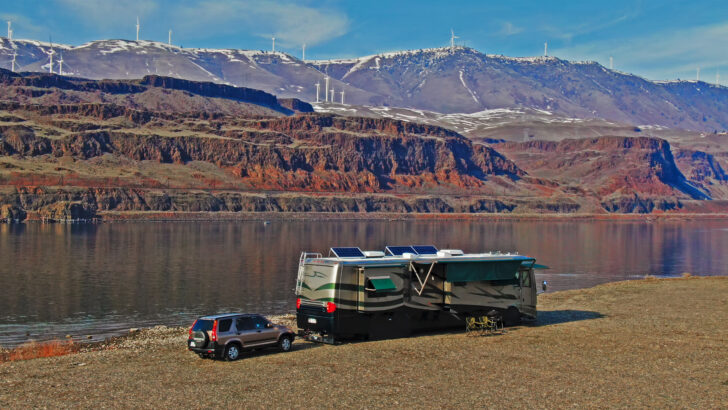

Because we often boondock in wide open spaces, we can face our RV in any direction. Any spot on the compass is available to us, so why do we always face East when we have the option (especially in the winter)? In this post, we’ll tell you exactly why we do that, and it might give you some ideas about what might work best for you.
Facing East isn’t the best choice for every RV or every situation. But when you see our reasoning, you’ll be able to tell what makes the most sense for you, too. Spoiler alert: It surely won’t surprise you to learn that the sun is a huge factor in all this! 🌞
5 Reasons Why We Park Our RV Facing East
Again, we’re not suggesting that facing East will work best for everyone because we recognize that other RVers may have different issues to address than we do. We also know that different floor plans mean that the components in other rigs are located in different areas of the RV from where ours are located on our motorhome.
That said, here are the five top reasons why we choose to park our rig facing East whenever possible, especially when we’re boondocking during winter months when days are shorter and the sun stays lower along the Southern horizon.
Morning Sun Position
When camped in desert locations during winter snowbirding trips, having the morning sun come in through our large windshield is a great (and free) way to help warm up the inside of the RV. It’s often chilly in the desert overnight, so we like having the sun warm up the rig as soon as possible after sunrise.
When the weather is warmer, and we don’t want the sun to come in on any given morning, we could leave the shades down and/or put up our outside windshield screens.
If we were to face our rig in the opposite direction during warmer weather, the hot afternoon sun would come right through that big windshield and into our living space, heating us up too much. So even in the summer, having the afternoon sun hit the rear of a motorhome (where there’s no windshield) is usually preferable, since it’s better insulated back there.
Awning Placement
Facing the RV East places our awning on the south-facing side of the RV. This allows us to use the awning to help keep the side of the RV cool and/or to provide a shaded area to sit on the patio. Yes, we could sit in the shade on the North (left) side of the RV, but that’s not the “patio” side!
Most RVs designed for use in North America or on the European continent have the main patio awning on the right side. In countries that drive on the left (Australia, England & New Zealand, for example, all of which we’ve RVed in), the awning is usually on the left side since that’s the “curb-side” or “patio-side” or “door-side” when you drive on the left.
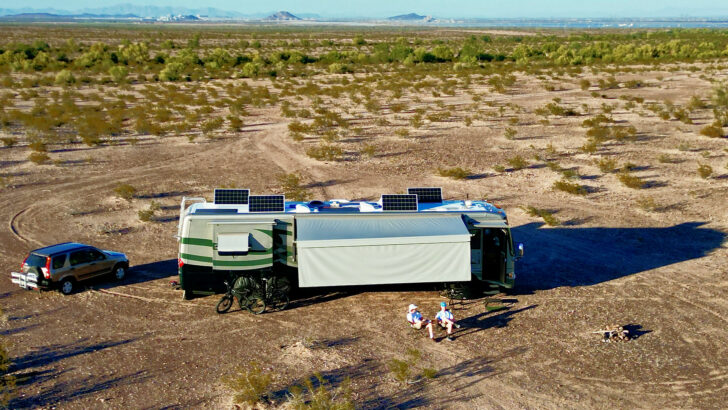
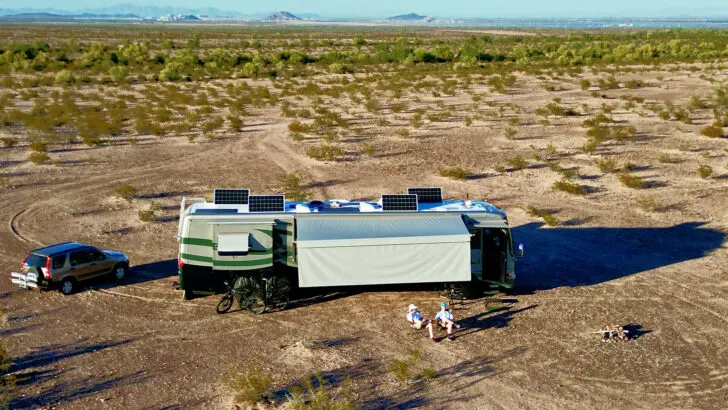
Here we are facing East, as usual, during a Desert SW winter boondocking trip. The awnings (and our Privacy Panel) provide shade on the southern/patio side of the rig. It’s late afternoon, with the sun on the rear of the RV, which blocks heat more effectively than the windshield. Of course, our solar panels are tilted to suck up the rays!
If you’re looking for more shade and/or privacy, a Tough Top Awnings privacy panel can be a great addition to your rig, too.
Also, having the left side/driver’s side of the rig facing north has its advantages as well. First, no matter what time of year it is, the north side never gets any sun. That means we don’t need to put window awnings out on that side no matter how warm the weather gets. That’s especially nice when we’re in an area with a beautiful view, leaving the view to the North unobstructed by window awnings.
For the same reason, we only need to put our RV tire covers on the South side of the rig. The tires on the North side don’t get hit by the sun at all, so they don’t require as much UV protection. If we’re staying longer than a few days we’ll usually put all of our tire covers on anyway, but it’s one less thing to do when we’re setting up for a shorter stay.
Afternoon Sun on the Rear of the RV
Again, when the late afternoon sun hits the rear of the RV at the warmest time of the day, having our rig facing East keeps the heat away from the living area, so it stays cooler. That then gives the bedroom some time to cool down after sunset before it’s time to hit the sack.
Additionally, the rear of our rig is more heavily insulated. First, there’s no glass back there, and there are also additional areas of insulation like the gap between the rear fiberglass cap and the rear wall of the closet. The closet and other cabinets in the back act as a buffer, better keeping the heat out of the living space.
Refrigerator Location
With our floor plan, the refrigerator is on the driver’s side/left side of the RV. Our original refrigerator was a typical propane-powered RV fridge and we later installed a residential refrigerator.
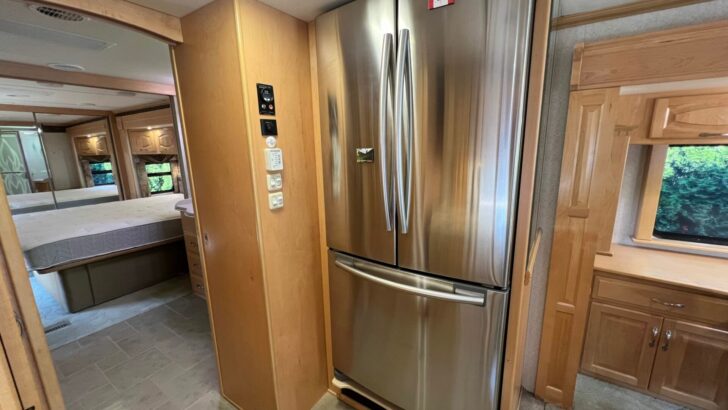
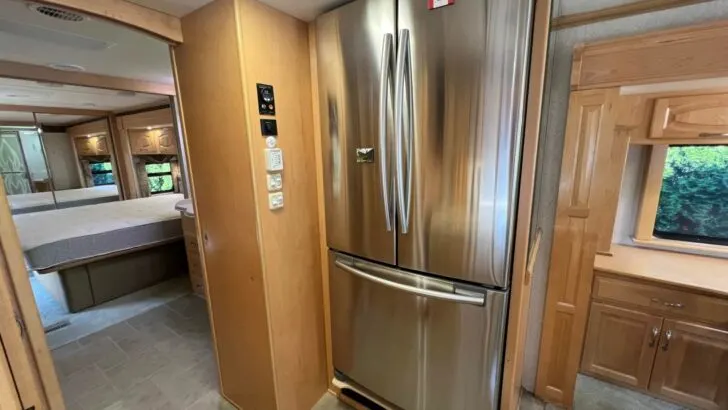
In the floorplan of our Newmar Mountain Aire, the refrigerator sits on the north (driver’s) side of the rig. This is one more good reason for us to choose to park our rig facing East whenever possible. This puts the fridge/north side of the rig where the sun never hits it.
Having that side of the rig facing north ensures that the refrigerator doesn’t have to contend with increased temperatures caused by the sun baking that side wall of the RV. This helps food to stay colder, and the refrigerator doesn’t have to work as hard.
Of course, your RV may have the fridge on the same side as the patio awning, so not every rig can be faced optimally for every situation. It’s all a balancing act. But there can be compromise solutions, such as installing a Privacy Panel and keeping it, and the patio awning, out over the fridge on sunny days. Every rig is different, and so are each RVer’s priorities.
Optimal Solar Panel Angle
We’ve saved the elephant in the room for last — solar power production.
If you have tiltable solar panels, the direction you face them can make a HUGE difference in how much power you produce. That’s most important during shorter winter days when the sun stays low on the Southern horizon. For us boondockers, this is the most important consideration of all.
Half of the solar panels in our M0untain Aire’s rooftop solar array are on electrically operated lifts, but they can only tilt the panels in one direction. We mounted them so that the panels tilt toward the passenger/curbside, so they’ll be facing the South when the RV faces East.
Tilting our panels toward the low-in-the-southern-winter-sky sun increases their output by about 25-35%. During those short winter days, maximizing solar output is more important than ever. For more, check out our video about why we park our rig facing East whenever we have the opportunity:
Since you rarely get the choice of which direction to face when parked in a campground or RV park, our reasons for facing East are most usable in non-designated camping spots like BLM boondocking areas. But having shore power allows you to manage your environment much better without having to concern yourself with the direction your rig is facing anyway.
PRO TIP: A caveat: In the hottest part of the summer (which coincides with longer days and higher sun angle — both good for added solar power), we occasionally opt to face North. That prevents the sun from ever shining directly into our motorhome’s big windshield, keeping us cooler. When too much heat is the biggest consideration, keeping the largest glass areas out of the sun can be the most important decision. And while we can’t tilt our panels to the South, tilting them isn’t needed in summer anyway.
Of course, the type of RV you have, floorplan, window locations, etc., will affect the best direction to face your rig. Obviously, a fifth wheel with a large rear window may be better facing West for the same reasons we face East. The point of this isn’t to say that every RV should face East. It’s to list the factors that makeus face that way so you can figure out what works best for your RV’s layout.
Which Direction Do You Face Your RV When Given the Choice?
Depending on the type of RV and floorplan you have, you might want to face some other direction when you have a choice. Maybe your fridge is on the other side of the rig or you have a fifth wheel with a large window in the back. Maybe you only camp in the summer in the forest, so sun angle, solar panels, and all the rest of this aren’t that important to you.
Whatever your situation, we hope our reasons for facing East provide some food for thought about which direction you might want to face your own rig when you’re boondocking.
For more tips about camping off the grid, check out our other related posts: 27 boondocking tips, the 11 best ways to find RV boondocking spots, the 7 best free camping apps for the avid boondocker, and our complete guide to Class A RV boondocking.
Free RVing Tips, Tricks, Reviews & Giveaways
As 20-year full-timers, we share everything we’ve learned about RVing over the years. Join our online community to receive a wealth of great RVing knowledge delivered daily to your inbox.
Whether you’re a new RVer or a seasoned full-timer, you’ll love the wide range of RVing topics we cover. Don’t miss a single article or any of our famous Giveaways. Subscribe to our newsletter today!
Bill
Thursday 18th of April 2024
Great info about RV orientation. Do you have recommendations for window tinting a motorhome?
TheRVgeeks
Thursday 18th of April 2024
Hi Bill. No, we don't have any recommendations (pro/con, installers, etc) for window tinting. We can tell you that both of our motorhomes came with tinted windows (the Mountain Aire's being darker than our original Bounder Diesel) and we liked them. They definitely kept things more private inside, so you felt less like a fish in a bowl in tight campgrounds. And because it kept it dimmer inside, it at least FELT/SEEMED like it was keeping things cooler, too.
But, if either RV hadn't come with windows that were made with tint, we're not sure we'd have gone through the trouble to have them tinted (both for the relative cost of doing it... and some concern that applying a tinting film to the glass wouldn't hold up as well over time).
Will B.
Tuesday 16th of April 2024
We have a fifth wheel and when we're boondocking and not in a campground (which is more often the case, so far) we also try to face east. Your post explains the good reasons, I guess, for what many of us do instinctively.
For us, we don't have tiltable panels, but have now purchased some additional portables, and that will help once I wire them in. (Two computers, external monitors, big NAS... we can be a bit power hungry.) Also, our fridge is on the south side, unfortunately. But, much like your big Class A windshield, we have a GD 399TH side patio, and that's *our* big window to let the sun in when we're sitting in Quartzsite or other great boondocking areas.
Ed Fogle
Tuesday 16th of April 2024
I prefer to face north most of the time. We are more likely to sit outside in the evening rather than morning. So when it’s the hottest part of the day the RV and awning shade our sitting area. If we faced east the awing wouldn’t shade us from the morning or evening sun. BTW, I find it rare RV parks are layed out for north facing sites. Of course we might choose a different direction if there is a better scenic view.
Matt
Sunday 25th of August 2019
Hey Fellas, I am heading to Utah (Bryce and Zion is all we have time for) next May and ideally wanting to boondock on BLM or FS sites etc. never been before. There seems to be some info out there, but most of the videos/info I can find are folk that are tenting or converted vans and such. I’m just wondering, if some fellow Newmar diesel pusher folk have some words of wisdom? Places you’ve stayed where the roads were good? Or places to avoid? I’ve been to some places before, where people that don’t own diesels, suggested to go to, that weren’t ideal for getting a diesel to. So I tend to take caution from others, but if you had some advice, I know it’d be good. If I was thinking, I should have picked your brains at Buttle Lake two summers ago ;)
Joseph Lopez
Tuesday 16th of April 2019
very good info, thank you for sharing! Appreciate all your good info
TheRVgeeks
Tuesday 16th of April 2019
Thanks, Joseph!