


As we head toward the dog days of summer, we’ve gotta talk about staying cool in hot weather. We recently published a post with 11 tips on how to keep an RV cool in summer. We’ve also got a post on 6 tips to try if your RV AC is not cooling. But today’s post features some ideas for how to keep yourself cool, particularly if you can’t use AC. So, read on for some thoughts on how to stay cool in an RV without air conditioning!
- 1) Don’t All RVs Have Air Conditioning?
-
2)
How to Stay Cool in an RV Without Air Conditioning
- 2.1) Fans
- 2.2) Mist or Wet Cloth
- 2.3) Go Barefoot
- 2.4) Wear a Wet or Frozen Neck Gaiter
- 2.5) Ice Packs or Frozen Water Bottles Under Pillows
- 2.6) Cool Cotton Sheets
- 2.7) Use Your Roof Vent Fans
- 2.8) Cover Windows & Skylights During the Day
- 2.9) Stay Well Hydrated
- 2.10) Shower in Cool Water Before Bed
- 3) What Measures Do You Take to Stay Cool in the Summer Heat?
Don’t All RVs Have Air Conditioning?
While many RVs do have air conditioning, there are several types of RVs that don’t offer this feature.
Moreover, there are RVers with AC systems that aren’t working for one reason or another. They’re not about to let the lack of AC stop them from traveling, but they do need some tips for staying cool in the summer heat.
And finally, there are many RVers who aren’t able to run their AC unless they’re connected to shore power. For those of us who love boondocking, that’s a limitation we don’t want holding us back, so we’re happy to find alternative ways to stay cool when necessary.
How to Stay Cool in an RV Without Air Conditioning
So, let’s talk about keeping yourself cool when you’re inside an RV without the option to use air conditioning, and the ambient temperature is HOT.
Fans
Perhaps the most obvious suggestion for how to stay cool in an RV without air conditioning is to use fans to cool yourself as well as to cool the RV.
The most common fans to use while camping are either 12V fans or battery-operated fans.
One of the most popular 12V/24V options among RVers and boaters alike are these Sirocco cabin fans by Caframo. They offer a low current draw, 360-degree directional airflow, 12V/24V auto-sensing, 3 speed settings, and 4 timer settings. They’re easy to install and can fold flat up against a wall when not in use.
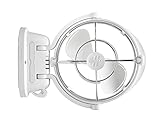
- 185 CFM on high (314 m³/hr), Current draw on low 0.06A (24V) and 0.12A (12V), Current draw on high 0.21A (24V) and 0.35A (12V).
- Unique gimbaled design allows complete 360° airflow with ultra quiet operation (54dB on high).

Caframo also makes a grill-free 12V option in its Ultimate 757. These compact cabin fans also draw low current and offer 360-degree directional airflow with a tilting head and finger-safe blades. They’re good for tight spaces and tap into the RV’s electrical system.
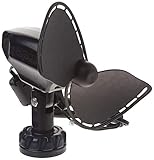
- Compact, grill-free cabin fan with patented Finger Safe blade
- 2 Speed settings for maximum comfort
There are also 12V options that plug right into any 12V outlet rather than needing to be installed in one location in the RV.
One such option is this Boundless Breeze RV/marine fan with three settings. Note that reviewers state that while this unit does move a significant amount of air, it does so at the expense of a fair amount of noise:
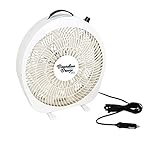
- Perfect for your RV, car, boat and more
- Ten powerful blades offer quiet operation even at high speeds
Then there are the small, clip-on style 12V fans which can be moved from location to location as necessary. These also plug into any 12V outlet and have the option to oscillate.
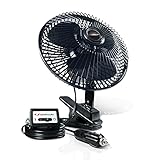
- COOLING POWER: Effective air circulation for cooling cars, trucks, buses, RVs, or boats; works with your vehicle outlet
- QUIET OSCILLATION: Quiet, reliable air flow and oscillating motion for full-coverage cooling
And finally, there are a number of battery-operated fans available as well. As always, it’s important to read reviews at all levels to make sure you’re not getting a fan that requires new batteries every day.
These small portable fans are available in 5-inch and 10-inch options and are good for laying a cool breeze on you wherever you are. They fold and store easily and operate on the power of a couple of D-cell batteries (not included), and tend to have good reviews.
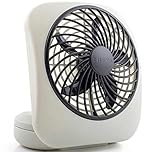
- BATTERY POWER FAN - This 5-Inch portable fan from Treva runs on 2 D batteries (not included), cool gadgets for an awesome office desk accessories or...
- COMPACT DESIGN: This mini fan won’t take up much space and features a convenient folding design, so you can use it as a window fan or travel fan to...
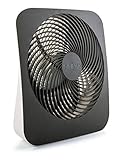
- BATTERY-OPERATED POWERFUL PORTABLE FAN : With Treva’s 10" popular Fan, you can cool off wherever you are. Perfectly sized, it is easy to transport...
- DURABLE CONSTRUCTION: This desk fan is durably crafted using sturdy plastic construction for long-lasting use with a patented fan blade design which...
There are so many options for fans that we should probably do a post just on 12V fans at some point. But for now, you’ve got a starting point if you’re interested in looking into fans as a means of staying cool in your RV without air conditioning.
Now here’s the real trick where fans are concerned…
Mist or Wet Cloth
In order to significantly heighten the cooling effect of a 12V or personal battery-operated fan, misting yourself with water or wiping your skin down with a wet cloth and THEN allowing a fan to blow over you will actually make you cold!
Of course, you could also just mist yourself or wet down your skin and that may be sufficient to keep you cool. But if you find yourself in a situation where there’s just no getting away from the heat, wet your skin and allow a fan to blow over you. You’ll cool down for sure.
Go Barefoot
This may go without saying, but we’ll say it anyway. Wearing socks, slippers, or shoes of any type will warm your body. Keeping your feet cool really does help to keep you cooler in general.
In fact, some people swear by putting clean cotton socks in the fridge or freezer to get them cold, and then putting them on to cool their feet so much that the entire body is cooled.
Wear a Wet or Frozen Neck Gaiter
Those of us who hike frequently are familiar with neck gaiters and buffs. These are tubes of material that are useful as sun or wind protection, but when wet they can act as a fairly significant cooling agent.
Wet the neck gaiter or buff to the degree that you have to wring it out. Either wear it like that or place it in the fridge or freezer for a while and then put it around your neck.
If you’re in very hot, humid weather, you may want to keep a few in the fridge so you’ll have some ready when the one you’re wearing dries out.
For those unfamiliar, these are neck gaiters and buffs:

- COOL MORE. DO MORE Enjoy staying active longer & doing what you love even when the temperature rises with the cooling & refreshing MISSION Cooling...
- COOLS INSTANTLY When activated with water it cools to 30 degrees below average body temperature in under 30 seconds! Activate quickly in 3 steps Wet...

- 4-way stretch

- Sport Type: outdoor lifestyle
- Sport Type: Outdoor Lifestyle
Ice Packs or Frozen Water Bottles Under Pillows
Many people swear by the cooling effect of a frozen ice pack or water bottle under their pillow on hot nights. Having a frozen ice pack or bottle nearby could certainly be helpful if you use it to cool your skin down as well.
Beware that if you’re freezing a bottle of water, you don’t want it to be more than ¾ filled with water when you put it in the freezer, as overfilled bottles can burst.
Also, be sure to keep the potential for condensation in mind, and consider wrapping the bottle or ice packs in a towel to prevent them from getting you, or your bedding, all wet.
Cool Cotton Sheets
Choosing cool cotton sheets is always important in summer, especially when you’re thinking about how to stay cool in an RV without air conditioning. If you’ve still got your flannel sheets on your RV bed, exchanging them for breathable 100% cotton sheets will make more of a difference in keeping you cool than you may think.

- Pure Cotton, Exceptional Quality: Made using 100% cotton, our twin size bed sheets feature a classic percale weave that’s cool, crisp, and feels...
- Slip into Ultimate Comfort: Woven from the finest cotton fibers, our percale bed sheets keep you cozy all night long. Certified by STANDARD 100 by...

- WINNER GOOD HOUSEKEEPING 2023 BEST BEDDING AWARD!: Wake up refreshed in all seasons with our certified 400-thread count soft, cool & comfortable 100...
- PERFECTLY SIZED WITH DEEP POCKET: Our 4-piece bedding sheets & pillowcases set includes 1 top sheet, 1 deep pocket fitted sheet with an all-around...
Use Your Roof Vent Fans
The roof vent fans in an RV offer an amazing amount of cooling ability when used in the proper manner for cooling the RV. The type with full-size fan blades that cover the entire opening move the most air.
The best way to use your roof vents to cool your RV is to run the fan so that it’s pulling air OUT of the RV, and crack open a window (or several of them) elsewhere in the rig. This allows air to flow through the RV, cooling the living space.
Some RV vent fans have the ability to blow in or out. In some circumstances, if the outside air is cool, you may want to draw the cool air into the RV. But if your goal is to cool the rig using the vent fan almost as a lightweight air conditioner, you’ll want the fan’s air blowing out, with a window cracked open.
Be sure to keep your vent fans clean for maximum effectiveness:
Cover Windows & Skylights During the Day
The sun penetrating an RV through windows and skylights during the day can leave the interior mighty hot. Blocking the sun can be helpful, especially during the hottest part of the day.
Just as shade is cooling, so is providing shade to the rig’s interior by blocking the windows and any skylights from the sun.
With motorhomes, the windshield is often the single largest source of heat. Keeping it covered with a windshield screen is one of the most basic steps you can take to keep heat out. And facing North to avoid direct sunshine on the windshield is a good idea as well.
A simple way to block your windows is to use a product like Reflectix (or another “bubble wrap insulation” product). These conform to any window shape and are lightweight and easy to store.
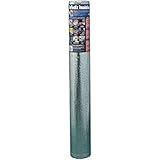
- Item Weight: 4.6 lb
- Country of Origin: China
There are products that insulate skylights from the sun’s heat as well. These are inexpensive and well worth using in both hot and cold weather.
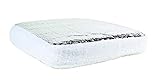
- RV VENT REFLECTIVE INSULATION: Camco’s vent insulator blocks the sun's damaging rays. It helps keep your RV cooler in the summer and warmer in the...
- SAVES ENERGY: This product reduces heat transfer and increases A/C efficiency.
Stay Well Hydrated
It’s always important to be well hydrated but it’s essential to replenish lost fluids in the heat of summer. This is true for so many reasons, not the least of which is the fact that your body can more efficiently cool itself if it is well hydrated.
In order to cool itself, your body perspires. It’s a stroke of genius, really, but it doesn’t work if you’re not well hydrated.
Your mother was right: hydrate, hydrate, hydrate.
Shower in Cool Water Before Bed
If you have the opportunity to shower while you’re camping, doing so in cool (but comfortable) water before bed helps to cool your body before you attempt to sleep.
If you can’t shower before bed, even wiping the day’s “stuff” away and cooling the body with a wet cloth is extremely helpful.
Many campers who aren’t able to shower daily use a product like these disposable washcloths to wash and cool the body prior to going to bed on those hot summer nights. They work, and they save water if you’re boondocking or just don’t have access to a shower.
No products found.
What Measures Do You Take to Stay Cool in the Summer Heat?
We’ve shared some tips for how to stay cool in an RV without air conditioning, but we certainly haven’t shared them all. What have you done to stay cool in the dog days of summer at times when you haven’t had access to RV AC? Please share your tips in the comments section below.
Geek Out with Us Every Week
Join our newsletter to learn about all things RV-related. Every week we offer free tips, tricks, product reviews, and more to our online community of RVers. So, whether this is your first time on the road or you’re a seasoned expert, we’d love for you to geek out with us!
Larry
Saturday 3rd of June 2023
U. S. Air Force desert survival training has proven the benefit of placing a wet cloth on each forearm and replacing the water as necessary to keep the cloth moist. In through testing they found that covering more of the body (such as an entire t-shirt) would risk overcooling which triggers the central body to start generating heat! Heat generation was also easily triggered by drinking cold beer (not that they recommended drinking warm beer! Nor did they say where to get cold beer in a desert survival siruation). I have personally tested the moist-cloth-on-forearm technique and have found it to be surprisingly effective even without adding a fan in a low humidity environment, such as the desert in Arizona, and also very helpful even in the somewhat humid summer heat of Lubbock, Texas. In Lubbock adding a fan boosted the cooling effect sufficient to halt my sweating.
TheRVgeeks
Saturday 3rd of June 2023
Can't wait to test this out. Thanks for providing some USAF survival training guidance, Larry!
Ro Bennett
Friday 2nd of June 2023
I made insulated/blackout window inserts (numerous YouTube DIY videos). We also use thermal-backed curtains on a tension rod room divider to partition off the cab (which can be closed while driving so the dash AC is more efficient while driving). Both of these definitely help with keeping the RV cooler in summer and warmer in winter.
I also made cooling neck wraps using Orbeez water beads. Keep them in the refrigerator. Cooling lasts a long time.
TheRVgeeks
Saturday 3rd of June 2023
Great tips, Ro. Thanks for sharing!
George Carrington
Friday 2nd of June 2023
As a former Letter Carrier for the Postal Service I would get a water-tight container, fill it up half way with water the night before, and put it in the freezer. The next morning I would fill it up the rest of the way and put a wash cloth in it. During the heat of the day I would take that cool/cold wash cloth out and wipe myself down with it. VERY refreshing!
TheRVgeeks
Saturday 3rd of June 2023
Sounds like a great solution, George!
Steven
Thursday 16th of June 2022
Crazy thing my grandmother taught me… wintergreen alcohol. Splash it all over you and it’s more cooling than water and the minty fresh wintergreen not only smells wonderful but it adds and additional tingly cooling effect. This is a super cheap solution as the bottle of wintergreen alcohol costs less than $2 at most places.
TheRVgeeks
Thursday 16th of June 2022
Great tip, Steven!
Ro Bennett
Friday 3rd of June 2022
We use thermal curtain panels and a tension room divider to block off the cab to reduce heat and cold coming into the living area of our class A motorhome.