
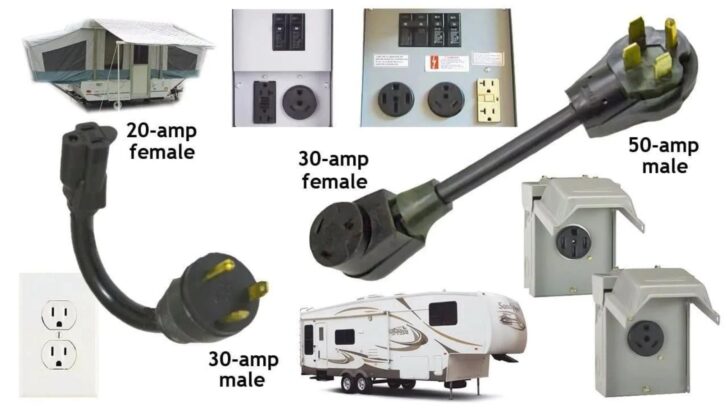

Recently, a new RVer asked us how to plug their RV into a household electric outlet. That reminded us that there are probably a lot of people with the same question. So, in today’s post, we’re going to cover the basics of connecting different types of RVs to 20-, 30-, and/or 50-amp electric service… using an RV plug adapter.
Being able to safely and reliably connect your RV to different sizes of power outlets means that you need to have the right RV power adapters. This is true whether you’re camping at a state park, a campground, or in a friend’s driveway. So, let’s dive into the different types of camper plug adapters available, and how to choose the right ones for your needs.
- 1) What Are the Different Types of Amp Services Available to Power an RV?
- 2) Which Type of RV Plug Adapters Do I Need to Use Different Amp Services?
- 3) Adapting Down: Connect Higher-Amperage RVs To Smaller Outlets
- 4) Can I Use an RV Plug Adapter to Adapt Up to a Larger Receptacle?
- 5) Conclusion: RVers Need To Adapt!
- 6) Free RVing Tips, Tricks, Reviews & Giveaways
What Are the Different Types of Amp Services Available to Power an RV?
First, let’s go over household electric services, the different amp-ratings of service available at campgrounds, and the amp ratings common to RVs.
A standard 3-prong household electric outlet can provide either 15-amp or 20-amp service. The maximum amount an outlet can handle is controlled by several factors, including:
- the circuit breaker protecting the circuit
- the gauge of wiring
- the capacity of the outlet itself
If your RV is small, like a tab or pop-up trailer without air conditioning, your electrical cord probably ends with the same household-style 3-prong plug for 15/20-amp service.
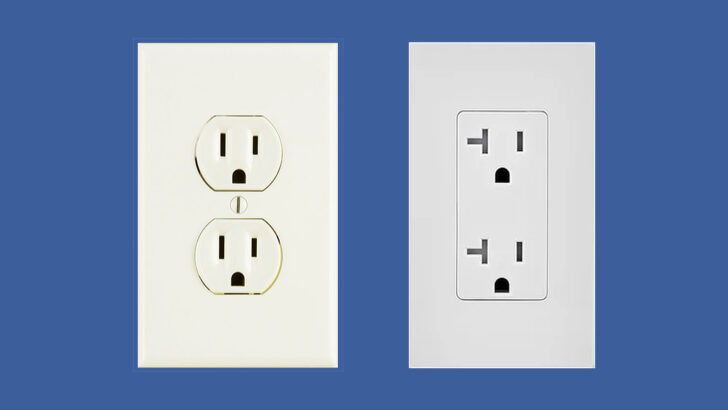
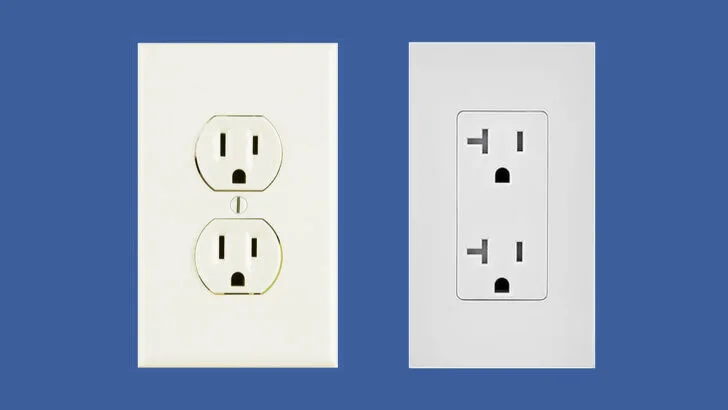
A 15-amp household outlet is shown on the left and a 20-amp outlet on the right. Note the T-shaped prongs on the 20-amp service shown on the right.
Most medium-sized RVs (usually with only one air-conditioning unit) have 30-amp service, which uses a larger three-prong plug with two of the prongs at an angle. The largest RVs (usually with two or three air conditioners) utilize higher-power 50-amp service, with larger, 4-prong plugs.
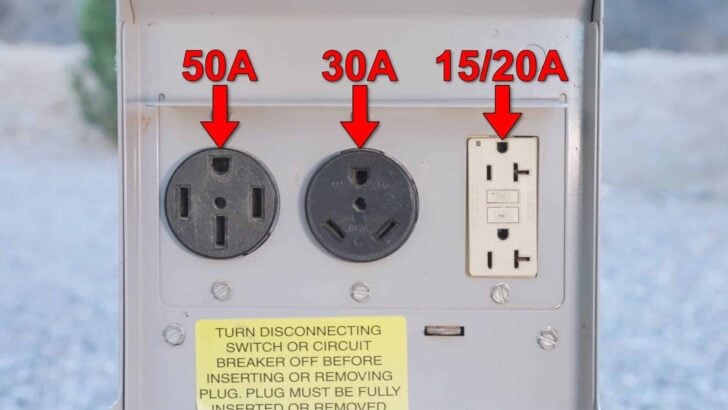
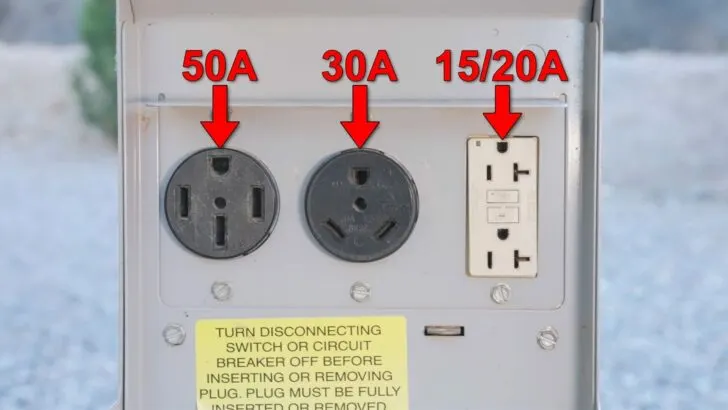
This is an example of a typical campground pedestal with 50A, 30A, and 15/20A outlets.
Which Type of RV Plug Adapters Do I Need to Use Different Amp Services?
Most RV parks offer, at a minimum, both 20- and 30-amp service, but there are many locations that offer 50-amp service as well. But what do you do if you’re staying at a park that doesn’t offer an outlet to match the amp rating of your RV’s power plug? The answer: Dogbones (a.k.a. electrical adapters).
Dogbone Adapters
A “dogbone” adapter (named for its resemblance to the canine treat) attaches to the end of your RV’s electric cord and steps it up or down to match an available outlet. A dogbone-style adapter has two bulbous adapter plugs separated by a short, heavy-duty cord (again, making them look like a dog’s bone). These will often have a molded handle on one side to make plugging it into (and removing it from) the power pedestal easier.
Since 50 amp service is often unavailable at smaller more rustic RV parks, just about everyone driving a large motorhome, fifth-wheel, or travel trailer carries at least one dogbone. A 50 to 30 amp adapter allows them to convert their big 50 amp plug to the smaller, 30 amp outlet. We’ve also always carried a second dogbone to further step down to 15/20-amp service.
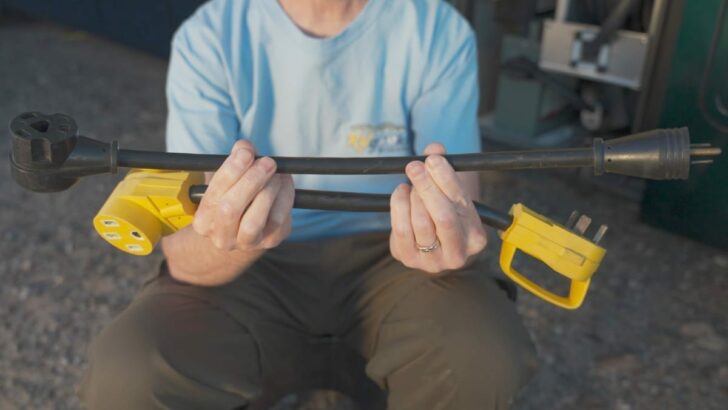
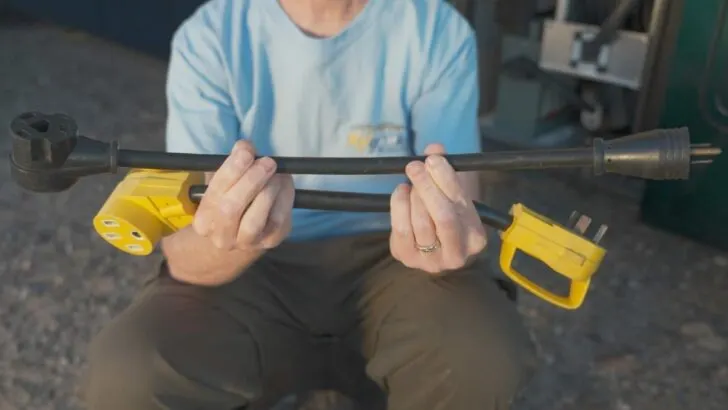
These two dogbone adapters have allowed us to step down our 50-amp plug to 30-amp service (yellow dogbone) or even to 15/20-amp service (black dogbone).
It may not seem possible to power a large motorhome on less than 50-amp service, but it’s really not a problem. It’s all about power management. For instance, we know we can’t run both of our air conditioners and our electric water heater element and our microwave all at the same time… unless we’re on 50-amp service.
That said, 30-amp service is plenty to run two or three items at once. For example, we spent an entire winter in British Columbia in our 50-amp Newmar Mountain Aire plugged in at a 30-amp site and had no problem at all. Again, you just need to be mindful of power management.
With the black dogbone shown above, we’ve even connected to a 15/20-amp service in some cases, allowing us to keep the batteries charged, watch TV, run our 120V residential fridge, power our computers, or even use the microwave. The trick is to remember to use certain appliances one at a time. It’s all about learning how much power each appliance in your RV uses… and living within the limits of the available electric service.
For instance, we would certainly never have expected to park in a friend’s driveway on a hot summer day powering both of our air conditioners by running a 15-amp extension cord to a household outlet in their garage. These larger power requirements demand at least 30-amp or even 50-amp service (of course, alternatively, we could fire up the generator if necessary).
It’s a real luxury on a brutally hot August day to pull into a 50-amp RV park, crank up both air conditioners, heat water for showers, and microwave dinner all at the same time. Just don’t expect to do that without that 50-amp connection.
Now, let’s use the example of plugging a 30-amp RV into a 15/20-amp power pedestal using a dogbone adapter. After turning off the appropriate circuit breaker at the pedestal, you’d first plug your RV’s 30 amp cord into the female end of the dogbone adapter. Then, you’d plug the other end of the dogbone into the 15/20-amp service outlet.
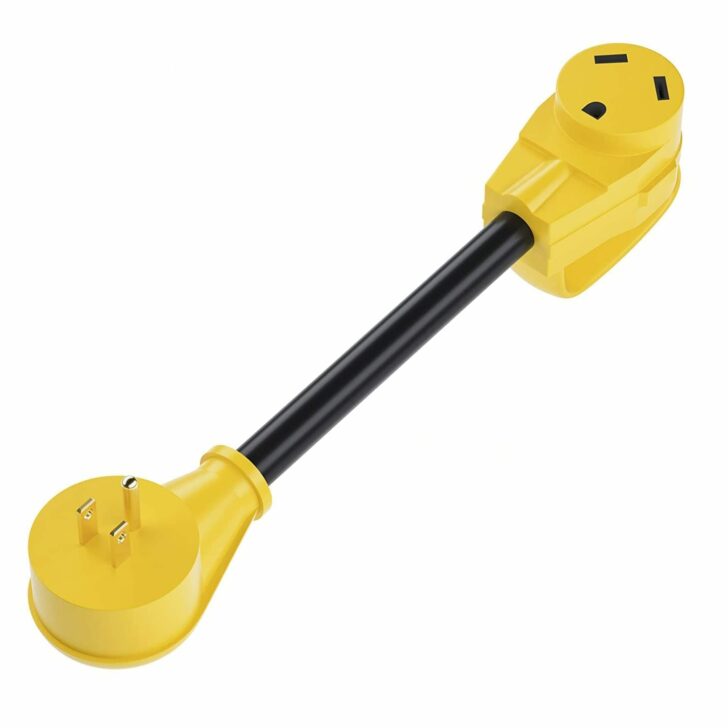
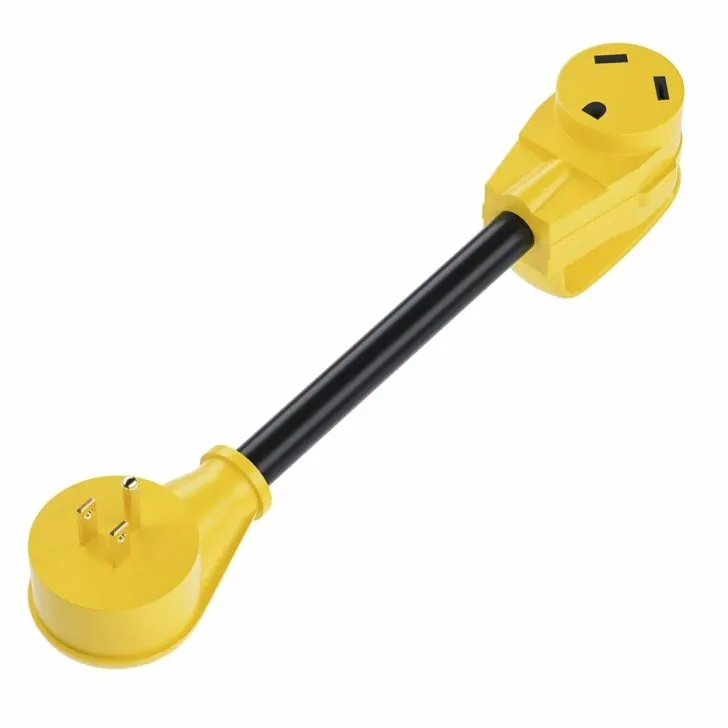
This dogbone allows a 30-amp RV power cord to plug into a typical household 15/20-amp outlet.
Everything in the RV will have access to power… but, again, just be sure that you don’t try to run too many 120-volt devices at once, or you’ll end up tripping the circuit breaker at the pedestal. Running off a lower amperage power source than your RV is able to use works great as long as you keep that limitation in mind, and don’t overload the circuit by trying to use too much power at any given time.
Here’s Peter in one of our older YouTube videos explaining exactly how to use dogbones to step down from 50-amp to 30-amp or 15/20-amp service, and to step up from 20A or 30A to 50A service if necessary.
Puck Adapters
Puck adapters work exactly like dogbone adapters, converting your RV’s plug to a different size/style. They’re a single small unit (like a small hockey puck) that has the necessary female outlet and male prongs to make the conversion… but they don’t have the short length of cable to connect the two plugs, like a dogbone style adapter does (see the examples below)
To use a puck adapter, you’d connect your RV’s power cord to one side of the puck adapter and plug the other end into the power pedestal (or an electrical outlet at your home). Puck-style adapters are convenient to use because of their smaller size, but have more limited options than dogbones do, generally being limited to 30-to-15 amp connections.
Adapting Down: Connect Higher-Amperage RVs To Smaller Outlets
Various RV plug adapters are widely available. Following are the adapters required to step down to various amp services.
Connect a 30A RV to a 15A Outlet
If you have a 30-amp RV plug and need to step down to a 15A outlet, this adapter for your camper plug should do the trick:
- CONVERTS ELECTRICAL CONNECTION TYPE: Easily hookup your 30-amp RV to a campground's power pedestal or an at-home 15-amp outlet with Power Grip’s...
- HIGH CONDUCTIVITY: Rated for 125 volts/1875 watts, the RV power adapter features 100% copper 10/3-gauge wires for superior conductivity. It includes...

Here’s a puck adapter that can do the same job:

- Adapter Connection: Designed to connect to a standard residential outlet and adapts the connection to fit your 30-amp RV
- Contoured Design: Allows for easy removal from the outlet
Connect a 50A RV to a 30A Outlet
If you have a 50-amp RV plug, here’s the dogbone you need to step down to a 30A outlet:

- Converts Electrical Connection Type: Designed to allow you to hookup to your campground's power pedestal, adapting the electrical connection to fit...
- High Conductivity: Heavy-duty 30-amp male (NEMA TT-30P) and 50-amp female (NEMA 14-50R) electrical heads. Rated for 125 volts/3750 watts. Constructed...
Connect a 50A RV to a 15A Outlet
If you have a 50A RV and you need to step down to a 15A outlet, you could use the two adapters listed above to first step from 50A down to 30A… and then from 30A down to 15A. But if you’d rather do it in one step (to avoid any extra connection points) you can use an adapter like the one below:

- Converts Electrical Connection Type: Designed to allow easy conversion from a 50-amp to 15-amp connection.
- High Conductivity: Heavy-duty 15-amp male (NEMA 5-15P) and 50-amp female (NEMA 14-50R) electrical heads. Rated for 125 volts/1875 watts. Constructed...
Can I Use an RV Plug Adapter to Adapt Up to a Larger Receptacle?
You can, but adapting up to a larger receptacle requires a warning. Because the pedestal’s breaker is now a higher amp capacity than your RV’s power cord, you’re eliminating some of the protection that the pedestal’s circuit breaker would provide for your power cord. So this must be done with care and really should be the exception and not the rule, used only if absolutely necessary.
For instance, if you’re adapting your RV’s 30-amp power plug UP to a 50-amp outlet, the pedestal’s 50-amp breaker may not trip (in time OR at all), which could leave your power cord vulnerable to overheating and melting. Clearly, this is a situation you want to avoid! (NOTE: in theory, the main 30-amp breaker inside your RV SHOULD trip to protect your cord if a condition caused you to draw more than 30 amps through the cord, but since the 50-amp breaker on the pedestal WON’T, you’ve eliminated a layer of protection.)
Connect a 15A RV to a 30A Outlet
In the rare case that you have a 15A RV that needs to be adapted up to use a 30A outlet (we’ve encountered RV parks that ONLY have a 30-amp outlet on the power pedestal), this adapter could be used:

- Converts Electrical Connection Type: Designed to allow you to hookup to your campground's power pedestal, adapting the electrical connection to fit...
- High Conductivity: Heavy-duty 30-amp male (NEMA TT-30P) and 15-amp female (NEMA 5-15R) electrical heads. Rated for 125 volts/1875 watts. Constructed...
Connect a 30A RV to a 20A Outlet
Here’s a 20 amp to 30 amp adapter plug for campers so that you can plug a 30A RV into a 20A service:

- NEMA 5-20P to NEMA TT-30R, Generator 20 Amp to 30 Amp Adapter Cord, 125/250V,ETL Listed
- NEMA 5-20P male connector can securely connect the generator to prevent the adapter from falling off
Connect a 30A RV to a 50A Outlet
In more than 20 years on the road full-time, we’ve only rarely come upon an RV park that only had 50-amp outlets at the park pedestals… but we HAVE seen it. If you have a 30A RV and find yourself needing to adapt up to a 50A outlet, you could do so with this adapter:

- Converts Electrical Connection Type: Designed to allow you to hookup to your campground's power pedestal, adapting the electrical connection to fit...
- High Conductivity: Heavy-duty 50-amp male (NEMA 14-50P) and 30-amp female (NEMA TT-30R) electrical heads. Rated for 125 volts/3750 watts. Constructed...
Conclusion: RVers Need To Adapt!
As you’ve just read, RV plug adapters are essential tools for RV owners… enabling us to connect our RVs to various power sources safely and efficiently. For more information on important RV electrical matters, be sure to see our posts on RV extension cords, RV surge protectors, and the Hughes Autoformer (protect your RV’s appliance and electronics from being damaged by low voltage power).
And if your RV’s electrical system often leaves you scratching your head, check out this article: RV Wiring For Dummies: Don’t Be Shocked By What You Don’t Know.
Free RVing Tips, Tricks, Reviews & Giveaways
As 20-year full-timers, we share everything we’ve learned about RVing over the years. Join our online community to receive a wealth of great RVing knowledge delivered daily to your inbox.
Whether you’re a new RVer or a seasoned full-timer, you’ll love the wide range of RVing topics we cover. Don’t miss a single article or any of our famous Giveaways. Subscribe to our newsletter today!
Roy
Monday 20th of November 2023
You didn’t discuss using a “two 30 amp male plugs to a 50 amp female” plug for 50 amp rv’s. I use it when the pedestal has two 30 amp plugs.