
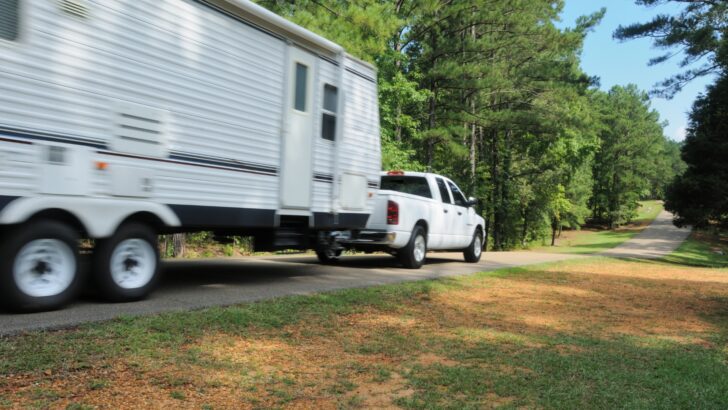

What’s the best half-ton truck for towing an RV? That’s a big, loaded question, and the answer depends on a range of factors.
If you’re planning to tow an RV, it’s very important to make sure that you do it with a truck that’s capable of towing the total weight of the trailer and has enough payload capacity to handle the weight of the driver, passengers, and cargo you plan to carry, as well the tongue weight of the trailer.
But as it turns out, finding a half-ton, full-size pickup truck’s towing capacity and payload capacity isn’t quite as simple as you might expect. That’s especially true if you don’t already own the truck, and plan to custom order one.
In today’s post, we’re looking at the best half-ton trucks for towing from the usual suspects (GM, Ford, Ram, etc). We’ll also sort through the details of half-ton pickup towing capacities and payload capacities, and what factors into those numbers. We’ll also explain why the manufacturers’ marketing claims can’t be taken at face value, and why it can be so tricky to figure out if you don’t have the actual truck sitting right in front of you.
How Do I Know a Truck’s Towing and Payload Capacities?
As you do your research for the best half-ton truck to tow your RV, it’s easy to find out the towing and payload capacities, right? Just pull up the manufacturer’s website online, and the information will be right there, crystal clear in black and white, right? Wrong!
While manufacturers like to tout their truck’s maximum possible towing capacity, they don’t make it easy (at all!) to find out the payload capacity. That’s an issue, since the truck has to be able to handle anything IN the truck (passengers, their stuff in the cab, and anything in the bed of the truck) along with enough remaining payload to handle a travel trailer with any significant tongue weight. That can limit their ability to safely tow anything larger than a very small camper, regardless of their towing capacity.
It can be surprisingly challenging to find out the towing capacity, and especially the payload capacity, of a new truck. The information is just not readily available unless you’re standing right there at the truck. That’s fine if you already own a truck, and want to figure out what kind of RV you can pull with it. But what if, as we’re currently doing, you want to order a brand-new truck to tow an RV you plan to buy or already own?
The second problem is that the numbers reported by manufacturers are often tied to one very specific configuration. That means even small changes in trim level, options, packages, cab configuration, bed length, engine, or transmission can reduce the size and weight of the trailer you can tow by a lot. And the model with the maximum payload capacity may be achieved with an entirely DIFFERENT combination than what’s needed for maximum towing!
For example, here’s what Ford’s website says about the 2024 F-150:
What is the max towing capacity?
The available max tow weight rating for F-150 pickups vary depending on model and engine size. The highest max towing capacity is 13,500 lbs.*
* When properly equipped. Max towing of 13,500 lbs. available on F-150 SuperCrew 6.5’ box 4×4 with available 3.5L V6 engine. Class is Full-Size Pickups under 8,500 lbs. GVWR. When properly equipped. Max towing varies and is based on accessories and vehicle configuration. See label on doorjamb for carrying (payload) capacity of a specific vehicle.
So, when you see an ad that says “13,500-lb maximum trailering capacity,” it’s easy to be misled because that number doesn’t apply to the entire lineup for that make and model of truck. It won’t even apply to most of the lineup, but only to very specifically-equipped trucks. The actual capacities can vary based on so many factors, options, and packages that sorting through the details can be overwhelming. And is likely what makes it so hard to uncover when you’re shopping.
Generally, the only surefire way to know what the payload and towing capacities are for a specific truck is to look at the label/placard installed on the truck by the manufacturer. This is generally located on the driver’s side door jamb. And even that assumes that nothing significant has been added or changed by the dealer (or a former owner, if you’re buying used).
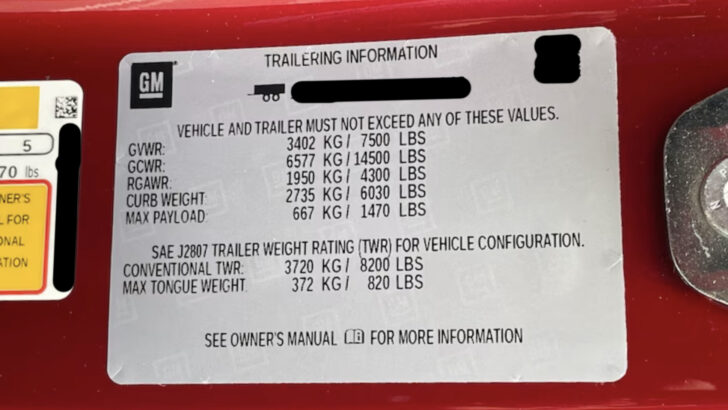
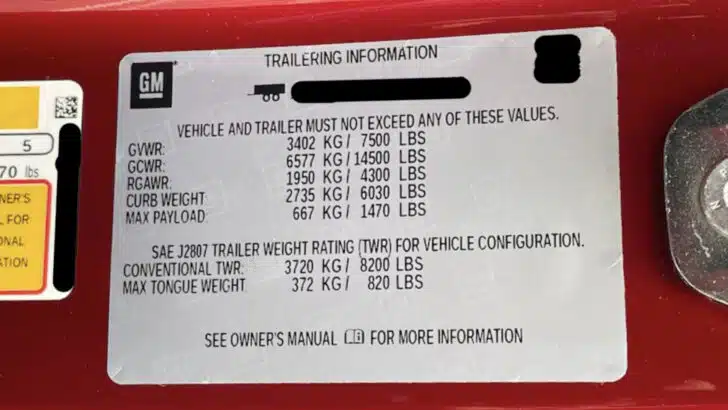
This is a typical placard found on the driver’s door sill, with critical weight limits listed for towing. But what do you do if you’re custom-ordering a truck, or buying a used one that’s been modified?
What Factors Influence a Truck’s Towing Capacity?
Regardless of what any manufacturer promotes, both the towing capacity and payload of a particular truck can be affected by factors such as:
- Cab configuration (2-door vs crew cab, etc)
- Truck bed size (long or short bed)
- Trim level (for example, the GMC Sierra 1500’s maximum reported towing capacity is only available on one of their many trim levels)
- Engine type and size
- Transmission type
- Drivetrain (2-wheel vs 4-wheel drive)
- Wheel/Tire size (here again, the GMC Sierra requires 20” wheels to achieve the maximum trailering rating)
- Rear axle ratio
- Options/Packages (some truck manufacturers have a special “Max Trailering” or “Max Towing” package that upgrades suspension and drivetrain components to achieve their advertised maximum towing capacity/trailer weight and/or maximum payload.)
So, not only is it impossible to provide a simple one-size-fits-all (or even most) answer to the question, “How much can a half-ton truck tow?” but it’s also nearly impossible to evaluate the highest tow rating and max payload on any given truck without knowing the intricate details of that specific truck.
NOTE: Regular readers of this blog (and followers of the RVgeeks YouTube channel) already know that we have a brand-new pickup truck and a new towable RV on order. We’ll reveal here now, for the first time, that the truck we’ve ordered is a 2024 GMC Sierra 1500. The reason we’re so up-to-date on the tricky process of ordering a truck to meet very specific towing needs is that we’ve just been through it (with “it” being the wringer!) 😂 Keep reading for more details.
With all of these factors and challenges in mind, let’s take a look at some of the best 2024 half-ton trucks for towing an RV safely and securely.
Best Half-Ton Trucks for Towing
The 2024 half-ton truck lineup offers a range of options for RVers seeking towing and payload capacities that will safely meet their needs. Keep in mind that we’re covering 2024 half-ton pickup trucks, and things can and do change from year to year, or even within model years. Be sure to do your homework… the best half ton for towing YOUR trailer may be different than for someone else.
GMC Sierra 1500
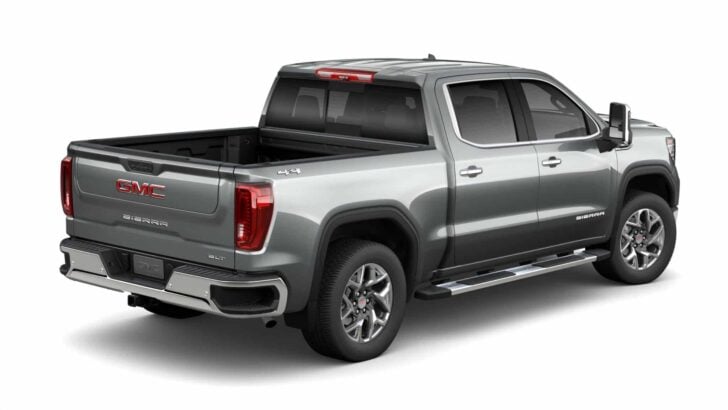
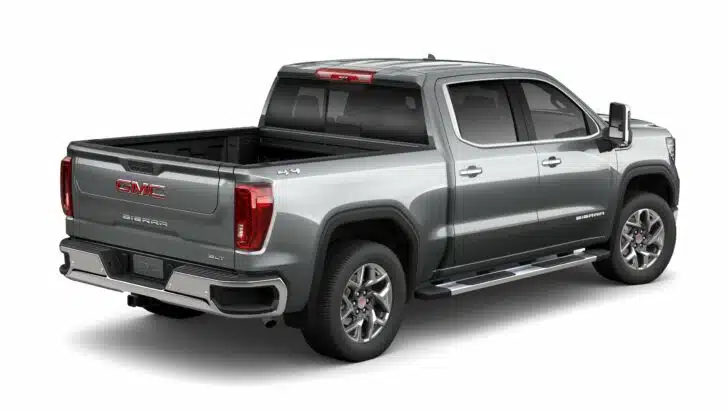
This is the exact truck we have on order — a 2024 Sterling Metallic GMC Sierra 1500 SLT Crew Cab, Short Bed, 4WD with the 3.0 Duramax Diesel engine, identical to the one in this photo from our build sheet.
As we just revealed that we’ve chosen (after lots of research) a GMC Sierra 1500 ourselves, it should come as no surprise that we think this is the best half-ton pickup truck… for our towing needs. But, it may also be right for you.
The 2024 GMC Sierra 1500 brings a wide variety of features and styling to the table. With powerful engine options and advanced towing technology, the Sierra 1500 competes strongly in the half-ton truck market. GMC offers the following engine choices:
- 2.7-liter base “TurboMax” turbocharged 4-cylinder (310 hp and 430 lb-ft of torque)
- 3.0-liter Duramax diesel (305 hp and 495 lb-ft of torque with impressive fuel economy numbers of 23 mpg city / 29 mpg highway!)
- 5.3-liter V-8 (355 hp and 383 lb-ft of torque)
- 6.2-liter V-8 (420 hp and 460 lb-ft of torque)
The Sierra 1500 is one of the best-selling vehicles in the U.S. and one of the strongest-towing pickups in its segment. Its upscale interior and towing-focused features make it an attractive choice for RV owners seeking a blend of capability and luxury.
Configured correctly, the Sierra 1500 is capable of towing (via ball-hitch) a maximum of 13,300 lbs (when configured with double cab, standard bed, 2WD, 3.73 drive axle ratio, 3.0L Duramax Diesel, and Max Trailering Package). But if you want to tow a 5th wheel, the max towing capacity is significantly different at 9,700 lbs (regular cab, long bed, 2WD, 3.23 axle ratio, with the 5.3L V8 engine).
And if you’re not careful, the wrong combination of features on the truck could result in numbers as low as 8,700 lbs for ball-hitch towing or 5,900 lbs for a fifth wheel. That’s a BIG DIFFERENCE! And a far cry from GMC’s numbers they love to put in advertising!
For more detailed information about towing capacities of different GMC Sierra 1500 configurations, check this article from GM Authority (no affiliation with GMC): https://gmauthority.com/blog/2023/12/here-are-the-2024-gmc-sierra-1500-towing-capacities/
As we mentioned, important payload and towing capacities (and other details) are listed on a plate in the driver’s doorjamb. So what do you do if you place an order, like we did, and the truck doesn’t even exist yet?
Using GMC’s Build & Price tool, we were able to confirm that our new truck, as ordered, will be rated to tow a maximum of 12,900 lbs. But that specifically required us to start with a “2024 Sierra 1500 4WD Crew Cab, Short Bed SLT with 3.0L Duramax® Turbo Diesel engine and Max Trailering Package” to get that. We didn’t care about many of the things that come with the SLT trim level, but we had no choice if we wanted that towing capacity, which we did. We also had to order the 3.73 rear axle and 20″ wheels to get where we wanted to be.
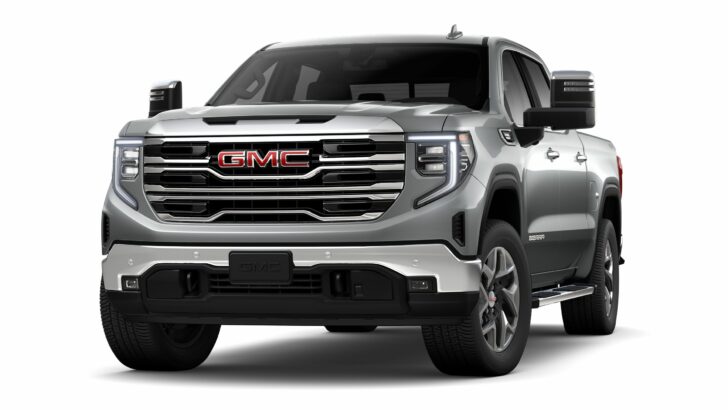
A front view of exactly what our new GMC Sierra 1500 will look like.
But what about payload? It may sound odd, but we don’t know exactly what the payload on our new truck will be. Until we see the actual door sill plate, it’s not possible for us to know. Even the dealer could only give us an estimate. Here’s how we dealt with that to make sure that both our half-ton truck towing capacity and payload can handle the new rig we have on order…
GMC’s system allowed us to confirm that our truck will come with a 7,300 lb. GVWR (Gross Vehicle Weight Rating). So we know how much it can weigh when it’s fully loaded up. But what we don’t (and can’t) yet know is the truck’s empty (or “curb”) weight. But we do have an idea — enough to be sure we have a payload capacity that will provide a safe buffer for us.
Based on all the options we’ve ordered (and, most importantly, with some assistance from our dealer) we’ve been able to confidently estimate that our truck’s curb weight will be no more than 5,300 lbs. Even if it were as high as 5,300 lbs, that would leave us with a usable payload of 2,000 lbs.
We figured in 180 lbs for each of us and 1,238 lbs for the maximum tongue weight of the trailer (8,250 lbs max gross trailer weight x 15%). 180 + 180 + 1,238 = 1,598. Subtracting that total from the estimated payload capacity of our truck (2,000 – 1,598) leaves us 402 lbs for all our miscellaneous gear.
Even if the truck comes in at the highest curb weight we’ve estimated (5,300 lbs), and the trailer was loaded all the way to the max (unlikely), and WE were loaded all the way to the max (off our diet, LOL), 402 lbs is more than the weight of the gear we plan to carry in the bed and backseat of the truck by a good margin. We’re good. But we won’t know 100% for sure until we see the sill plate and weigh the loaded truck, trailer, and tongue.
And yes, a GVWR of 8,250 is another hint about the size trailer we’ve ordered. Stay tuned (if you haven’t already done so, subscribe!) for more details.
Using our GMC Sierra experience as an example, whatever brand or model pickup truck you choose, be sure to do all your homework. When it comes to figuring out whether a certain pickup truck can tow a particular trailer, lots of factors have to be considered, not just the advertised maximum towing capacity.
You’ll also notice that we’re buying a truck that’s capable of towing a larger trailer than we’re getting. That’s for two reasons: 1) We want to future-proof ourselves to some degree, so if we decide to get a somewhat larger RV in a few years, we won’t automatically be forced to buy a new truck, and 2) It’s important to build in a safety margin.
You don’t want to use a truck with a 12,900 lb towing capacity to tow a 12,900 lb trailer. A safety margin of at least 20-25% is the safe, smart way to go. If you’re wondering why we didn’t simply buy a 2500 (3/4-ton) truck and not have to worry about it, we didn’t want the added size, weight, and cost of a bigger truck unless we had no choice.
We chose the GMC because we (1) like the look of it, (2) it can tow the weight we need and has the payload capacity to handle the trailer, and (3) it’s the only ½-ton truck that offers a diesel engine option for the 2024 model year (and the impressive fuel economy numbers don’t hurt, either… we’re used to having a 1,000-mile range in our diesel pusher, so whatever we can do to minimize the frequency of fueling stops will help).
The 2024 Sierra shares the GM T1 platform with the 2024 Chevy Silverado 1500.
Chevrolet Silverado 1500
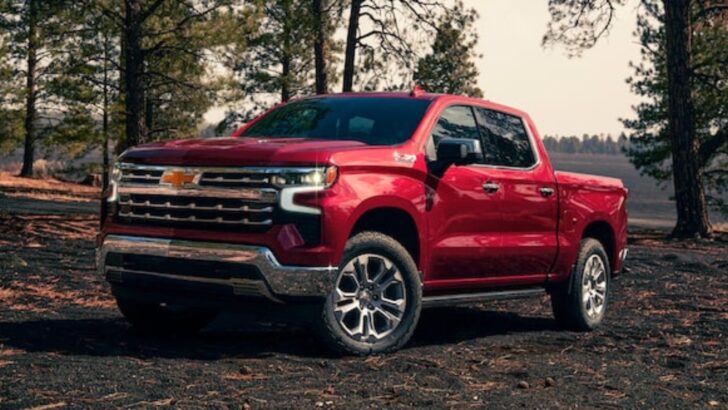
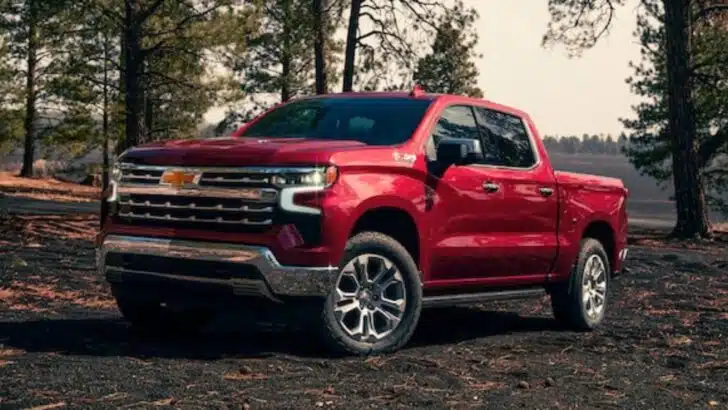
A 2024 Chevy Silverado 1500
Sharing a platform with the GMC Sierra 1500, the 2024 Chevrolet Silverado 1500 is another contender in the half-ton truck segment. With a variety of engine choices, including powerful V8 options, the Silverado offers impressive towing capacities as well. The standard TurboMax engine makes 430 pound-feet of torque while still being rated at up to 22 MPG on the highway. Upgrading to the 5.3L V8 engine provides 355 hp, while the 6.2L V8 brings 420 hp.
In addition, the Silverado’s robust frame and advanced towing features provide a safe and stable towing experience, making it a worthwhile choice for RV owners looking for reliability and power.
Because of their shared platform, the Silverado has towing capacities that are very similar to the GMC Sierra. The highest ball-hitch towing capacity is 13,300lbs (with the Duramax diesel engine, Max Trailering Package, and 20-inch wheels in either the double cab, standard bed, 2WD configuration or the crew cab, short bed, 2WD, OR if you’d rather have the 6.2L V8 engine you need to order it as a double cab, standard bed, RST trim, 4×4, with the Max Trailering Package and 20-inch wheels).
Again, for more specifics about the towing capacities of various Silverado configurations, check out GM Authority: https://gmauthority.com/blog/2023/10/here-are-the-2024-chevy-silverado-1500-towing-capacities/
Ford F-150

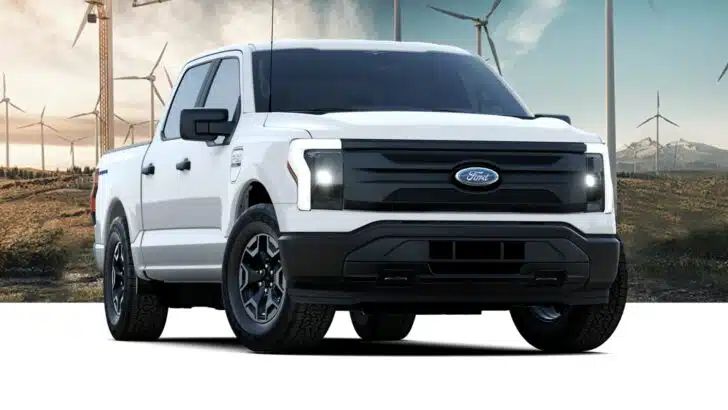
A 2024 Ford F150
As the best-selling passenger vehicle in the USA for something like the past 150 years, the Ford F-150 has long been a staple of the pickup truck world. The 2024 model maintains its reputation for great towing capability. Equipped with powerful engine options, including the twin-turbo 3.5L EcoBoost V6, 3.5L PowerBoost, 5.0L V8, 3.5L high-output engine, and 5.2L supercharged V8, the F-150 can tow an impressive range of RVs.
Ford reports that the maximum towing capacity is 13,500 lbs (in SuperCrew, 6.5′ box, 4×4, with available 3.5L V6 engine). Information for the towing capacities of other configurations wasn’t available for the 2024 model at the time of writing this article. But you can check out Ford’s RV Trailer & Towing Guide for the 2023 model year (in PDF format) for some idea of towing capabilities (including payload capacities for the base configurations listed… be sure to account for added weight for any options chosen).
Ram 1500
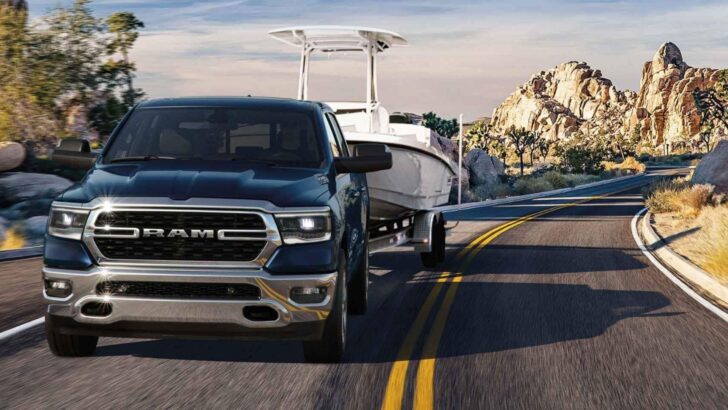
A 2024 RAM 1500
The Ram 1500 is another popular choice in the half-ton pickup category, with a luxurious interior and powerful performance. The 2024 model offers a range of engine options that provide good towing capabilities, including a 5.7L HEMI V8 with ETorque, the 3.6L Pentastar V6 with ETorque, and the supercharged 6.2L HEMI V8 engine.
Maximum towing capacity is rated at 12,750 lbs (when outfitted with the available 5.7L HEMI V8 engine with eTorque). More details are available in RAM’s towing guide for 2024 (in PDF format… and, again, payloads are listed, but be sure to account for changes due to any additional options).
The Ram’s suspension system and towing tech contribute to a smooth and controlled towing experience, making it a popular choice for RVers looking for both power and comfort.
Toyota Tundra
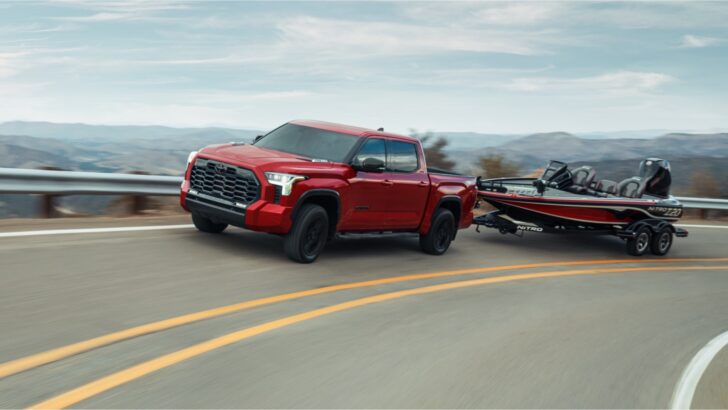
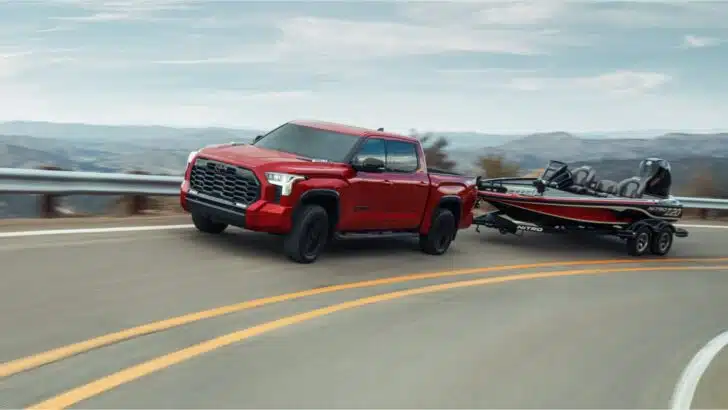
A 2024 Toyota Tundra
The Toyota Tundra got a redesign for 2024, with a new platform and engine options. With a focus on towing capacity and durability, the Tundra is equipped to handle some considerable loads.
For 2024, the Tundra got a new V6 Twin Turbo engine for more power and performance. A hybrid engine model with the i-FORCE MAX hybrid powertrain is also an option. All three power choices are based on a turbocharged 3.4-liter V-6 engine. The base model is tuned for 348 hp and 405 pound-feet of torque, while the other models offer 389 hp and 479 pound-feet of torque.
Opting for the i-FORCE MAX hybrid powertrain will net you a maximum towing capacity of 12,000 lbs. For more information about towing and payload capacities, check out Toyota’s website: https://www.toyota.com/tundra/features/weights_capacities/8372/8386/8424 (note that payload capacities are lower than for most GMC, Chevy, or Ford ½-ton trucks).
Toyota’s reputation for reliability is evident in the Tundra, making it a popular choice for travelers who value long-term performance and durability. However, the payload/cargo capacity of these trucks isn’t as high as their North American counterparts, so the tongue weight of the trailer becomes a significant factor.
Nissan Titan
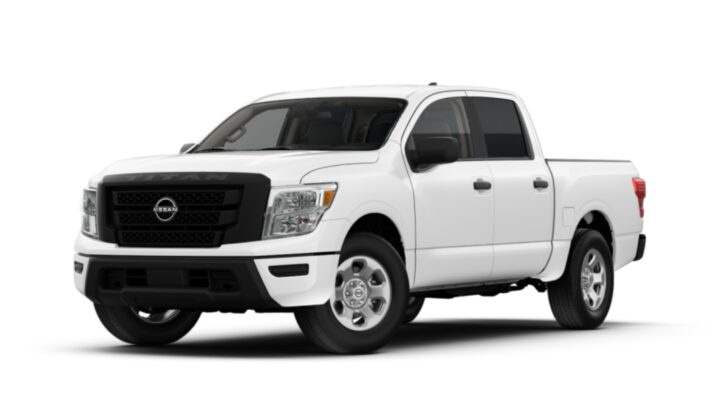
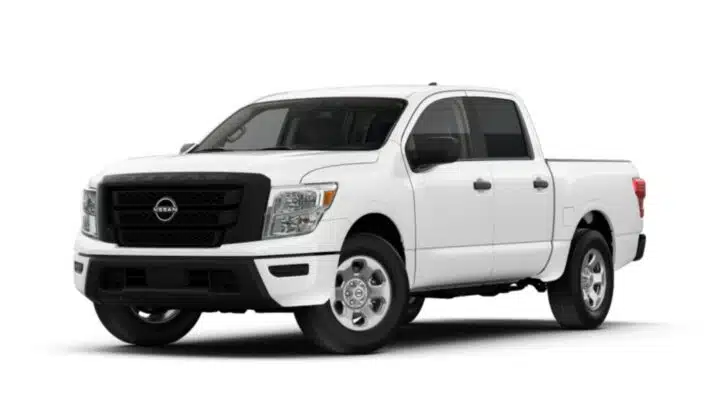
A 2024 Nissan Titan
The 2024 Nissan Titan maintains its reputation as a workhorse in the half-ton truck category. While the Titan may not be the first name that comes to mind when considering half-ton trucks for towing an RV, it’s worth considering as a reliable and capable towing vehicle in the right situations.
The 2024 Titan is powered by Nissan’s 5.6-liter Endurance V8 gasoline engine, which does require premium fuel. Rated at 400 hp, it gets a best-in-class rating for V8 powertrains and provides 413 pound-feet of torque. The engine is mated to a 9-speed automatic transmission.
Nissan reports a maximum towing capacity of 11,050 lbs, but doesn’t specify the trim/bed/engine/drivetrain combination that offers that capacity. To find out what a particular trim level offers in towing & payload capacities, you can check out Nissan’s Titan comparison tool (after picking a model & trim level, scroll down to the “Towing/Payload” section).
The Titan is equipped to handle a variety of towing demands. The engine’s performance and well-designed suspension system contribute to a smooth and controlled towing experience. It’s suitable for towing mid-sized to somewhat larger RVs. The truck’s payload capacity is also fairly competitive.
Final Note
In the end, it’s important to remember that knowing accurate towing and payload capacities is critical to towing safety. The research we do when planning the purchase of a truck to tow an RV is key. Don’t rely on what your friend tells you… or your dealer (either the truck or RV dealer). Do your own research!
It’s also crucial to understand that those capacities depend on specific trims/options/packages/engine & transmission combinations, and may require some serious digging to obtain… unless you’re standing right in front of the truck you’re interested in buying… or the truck you already own.
Free RVing Tips, Tricks, Reviews & Giveaways
As 20-year full-timers, we share everything we’ve learned about RVing over the years. Join our online community to receive a wealth of great RVing knowledge delivered daily to your inbox.
Whether you’re a new RVer or a seasoned full-timer, you’ll love the wide range of RVing topics we cover. Don’t miss a single article or any of our famous Giveaways. Subscribe to our newsletter today!
Dennis Weatherman
Wednesday 24th of January 2024
I respect the fact you ordered the vehicle specifically for your needs. I find it interesting that you chose a GM truck; every campground we've been to in the last 4 years Ford trucks are by far the highest percentage of trailer towing vehicles. F150 and the bigger trucks. Our truck is a 2013 F150 Ecoboost crew cab, 6'5" bed, 4x4. Pulling a 2021 Outback 252URS with ease all over the Rockies. We routinely pass Ram trucks on hills. 😀 Congrats on your new purchases, enjoy the ride. I'd like a new Ford but it's not in our retirement budget.
Luc Coulombe
Tuesday 23rd of January 2024
This is a surprise! I wasn't expecting you guys to go for a travel trailer. I can't wait to hear the whys and hows. Are you still going to travel full time?
TheRVgeeks
Tuesday 23rd of January 2024
LOL, Luc! We're trying to keep everyone on their toes! 😉