


Not every RVer needs a propane tank warmer, but if you enjoy winter camping (or if you live in your RV full-time in a cold climate), a propane tank warming blanket should probably be on your radar.
In this post, we explain what it is and why it’s an important cold-weather camping accessory.
What Is a Propane Tank Warmer & Who Needs One (and When)?
A propane tank warmer is a specially designed “blanket” that supplies just enough heat to keep the propane flowing as it should.
If you’ve ever camped in weather that’s below freezing, you may have wondered how (and if you need) to keep your propane tank warm in winter. The answer is a propane tank warmer blanket, sometimes called a propane tank heating blanket.
To be clear, this isn’t an item that every RVer needs. But if you like to RV in winter, or if you live in your RV full time and spend time where winter temps drop to freezing and below, or if you use and store your propane gas cylinder tanks outside or in a garage in the winter, a propane tank heater blanket is for you.
The reason a propane tank warmer is important is that when the ambient temperatures drop, pressure in an exposed propane tank can drop, too. This results in poor heating performance from your furnace and other propane appliances, and extreme conditions (the combination of low ambient temps + low propane level in the tank) can result in the flow of propane ceasing altogether.
Don’t let cold weather stop the flow of propane and leave you out in the cold!
Obviously, this is not what you want to see happen when you’re relying on your propane to keep you warm in your RV. Below freezing temps will start to slow the flow of propane. Once temps move down near -30°F, the flow of propane will be slowed so significantly that you may not be able to heat your rig. Propane stops boiling (i.e. converting from liquid ot a gas/vapor) completely at around -40°F.
Also, the warmer the gas in the tank is, the more BTUs you’ll get out of the gas when you burn it. So you’re actually saving money by warming your tanks, and the efficiency of your propane is enhanced by the increase in available BTU’s.
So, clearly, compressed gases like propane are affected by extreme cold. Optimizing the temperature of your propane tanks in the winter keeps the tank pressure where it should be. This is what a propane tank warmer (or propane cylinder heater) is for.
You may have seen our post on RV propane tank covers, and these are certainly helpful for a lot of reasons. But they won’t keep your tank warm in freezing temps. The safest and most effective way to deal with the cold is to use a propane tank/gas cylinder warmer.
Propane Tank Warmers
There are a few different tank warmers/blankets on the market. Some are fairly expensive, and some could be overkill for your purposes. However, you may be able to find a cheaper solution depending on how cold it tends to get where you camp (more on that in just a minute).
Let’s take a look at a few propane cylinder heaters.
Powerblanket PBL20 Gas Cylinder Heater
The Powerblanket PBL20 is a 20 lb propane tank warmer that fits 20, 30, and 40 lb LP gas tanks, safely heating the cylinder to an optimal 90°F / 32°C. The Powerblanket uses an inner reflective radiant insulation liner to help retain heat without adding excessive bulk to your tank.
This blanket is pricey, but it saves money by optimizing gas usage with continuous temperature control of propane and by insulating the tank at the same time.
The Powerblanket is certified to UL/CSA/CE standards.
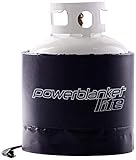
- Safely heats cylinder to an optimal 90 ° F / 32 °C (± 10 °F/5 °C)
- 120 Volt, 120 Watts, 1.0 Amp Draw

WXHDYBLANKET Propane Tank Heater
This propane tank heating blanket is also designed for use with 20, 30 and 40 lb LP gas cylinders. This is a 120 volt, 150-Watt, 1.25 amp heater with a max temperature of 104℉.
The blanket uses heavy insulation and a full wrap design that covers all or most of the gas cylinder, depending on the size of the cylinder. It’s IP67 waterproof and is made from a heavy-duty PVC material capable of withstanding both hot and cold temperatures.
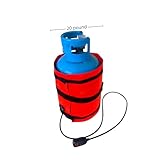
- This Propane Tank Heater is 120V,150W,1.25A,Max temperature is 104℉.
- ALL cover for Gas Cylinder Tank Heater,it have heavy insulation to keep the warm inside.
Propagate Pro PPHM-LP20
This 20 lb propane gas LP cylinder tank heater safely heats the cylinder to an optimal 95ºF | 35ºC. It’s compatible with 10-, 20-, 30- and 40-lb gas cylinder tanks. Like the PowerBlanket above, it has an inner reflective radiant insulation liner to help retain heat without adding excessive bulk to the tank.
Like other tank heaters, it saves money by optimizing gas usage by continuously controlling the temperature of the propane and insulating the tank at the same time.
We should point out that while this is the cheapest of the options we found on Amazon, it also doesn’t have the best reviews, so read them carefully before opting for this particular heating blanket.

- Warming blanket wrap, Safely heats gas cylinders to an optimal 95ºF | 35ºC (+/- 5º F / 2.5º C)
- Works on all 5#,10#, 20#, 30#, 40# and 100# Pound Gas Cylinder Tanks. Fits a variety of 4, 5, 6, 7 Gal Buckets & Pails
Alternatives to Expensive Propane Tank Heating Blankets
Before we get into a potential alternative for heating a propane tank, we want to mention that you should never use a space heater, hot water, or a blowtorch to heat your propane tank! There are no circumstances under which any of these options are even remotely safe.
We’ve read of some people using a utility light to keep their propane tanks warm in cold weather. However, we’ve also read about a utility light causing wires to melt and spark, resulting in an explosion and fire.
These types of interventions are never worth trying because they’re far too dangerous.
However, depending on how cold it is where you camp, it’s possible to wrap a propane tank in a thick, warm blanket or throw to help keep the propane warm.
Here’s a YouTube video in which this is suggested as a reasonable alternative to an expensive heating blanket. Just note that this would be unlikely to work in extremely cold temps.
Free RVing Tips, Tricks, Reviews, Giveaways & More
Subscribe to our daily newsletter! We’ve been full-time RVers for 20 years (!) and share everything we’ve learned about RVing in our daily blog posts. Join our online community to receive a wealth of great RVing knowledge delivered right to your inbox.
Whether this is your first time on the road or you’re a seasoned full-timer, you’ll love the wide range of RVing topics we cover. Don’t miss a single article or any of our famous RV gear Giveaways — Subscribe today!