
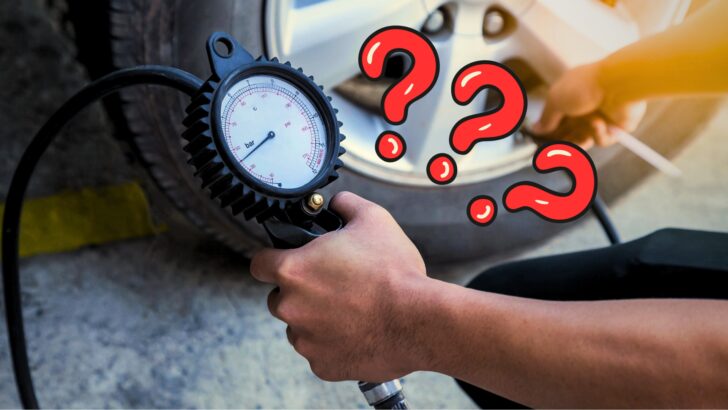

Accurate tire pressure readings can only be taken when tires are cold, often understood as any time before you’ve driven on them. But, really, what IS cold tire pressure, and are you sure your readings are accurate even if you haven’t driven on your tires yet today? Don’t be too sure!
Most RVers, especially us DIY types, are very careful about maintaining the correct tire pressure in our RV’s tires. But even if you understand cold tire pressure vs hot, and you’re diligent about checking your tires before every trip, you could still accidentally run them under their proper pressure. And since under-inflated tires are the primary cause of tire blowouts, this is essential information.
We realized this after we first started RVing when we confirmed our tire pressures and then rechecked them a few hours later, finding a dramatic difference between tires… even though we hadn’t moved the RV.
Today, we’re sharing the critical details because we know that if it never occurred to us, it may not have occurred to other RVers either.
What Temperature Is Cold Tire Pressure?
We want to start our answer to the question of what cold tire inflation pressure is by sharing our own experience:
We were getting ready for a long day of driving, so we were up early doing our PTI (pre-trip inspection). Before the sun came out, we checked the pressures of all eight tires on our motorhome using a quality tire pressure gauge — a standard part of any PTI.
We confirmed that all of our rear tires were exactly as they should be, including 85 PSI (pounds per square inch) on the drive and tag axles, the correct pressures for our axle weights (find out more here: RV Tire Pressure: You’re Probably Doing it Wrong!).
Our departure ended up getting delayed by a couple of hours, and when we were finally ready to roll, we did a second quick walkaround, including spot-checking tire pressures. We were shocked to find that some of the rear tires were way over 85 PSI!

- Heavy duty construction and rugged design for long lasting use
- Angled head and rubber coated handle for easy gripping

One side of the RV had been in the shade the entire time. The rear tires on that side of the RV remained at exactly 85 PSI. We also checked the temperature of the tire’s surface using our infrared thermometer and got a reading of 57° F.
- Wide Temperature Range: Measure an upgraded temperature range from -58°–1130°F / -50°–610°C and get your result in 500 ms; The display will...
- Professional EMS Mode: The Lasergrip 1080 Infrared Thermometer has an emissivity range of 0.1–1.0 for precise readings across different surfaces and...
The other side of the RV had been sitting in bright sunshine for the past couple of hours. We used our infrared thermometer to measure the surface temperature of the rear outer dual, and the tire was 107.5° F even though it was a pretty comfortable day out.
We wanted to know what effect that dramatic surface temperature increase had on tire pressure, so we measured that outside tire that had been in the sun. We found that the pressure in that tire had jumped a full 5 pounds per square inch to 90psi. The same thing was true with the tag axle tire just behind it, which had also been sitting in direct sunlight.
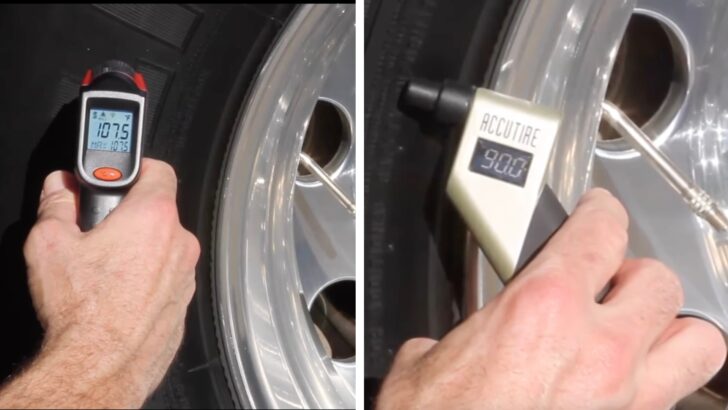
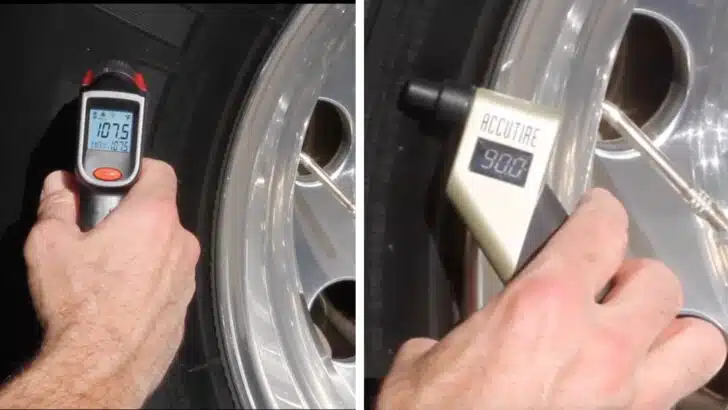
When we re-measured the surface temperature of the tire sitting in the sun, it had risen to 107.5 F, and the tire pressure had increased to 90 PSI.
Here’s the problem: Had we checked our tire pressure a couple of hours later than we initially did that day (after the sun was already shining on the tire), we may have mistakenly concluded that those tires were overpressure, and we would have let out 5 PSI. This would have left us driving on under-inflated tires, which is the number one cause of tire blowouts.
Do Tire Manufacturers Account for Temperature Changes With Their Recommended PSI?
Tire pressure recommendations account for some temperature fluctuations. Tire manufacturers factor some buffer into their recommended tire pressures to support each load. But the PSI settings listed on your door jamb, DOT placard, or owner’s manual aren’t necessarily the correct pressures to set your tires to. More important info on that below.
Cold tire pressures reported from a tire pressure gauge or TPMS (tire pressure monitoring system) will also FALL as the ambient temperatures drop (for instance, in the fall and winter). That means Spring and Fall are the most common times that RV owners may see tire pressures needing much adjustment up (in the Fall as it gets colder) or down (in the Spring when air temperatures start to rise).
But once you’ve set your cold tire pressures correctly, you’re unlikely to need to add or release air very often unless there’s a fair amount of change in outside temperature. Elevation changes also cause tire PSI to change, but not as significantly as temperature changes. If you see any significant reduction in PSI, especially in only one tire, it may be a sign of a slow leak. Stay on top of that!
Here’s the video we shot the morning our departure was delayed:
Pro Tips:
Here are a few tire pressure tips we use where changing temperatures and elevations are concerned:
- When we check our tire pressures in the Fall (as the ambient temps are beginning to drop, with average temps down to the 40s instead of the 70s or 80s, for example), we’ll add a little bit more air into the tires and bring their cold pressures up to about 3-5 PSI higher than normal. As long as you stay below the maximum PSI stamped into the tire’s sidewall, there’s no harm in airing the tires up several PSI above their recommended pressures. That counteracts continuing pressure drop due to continuing temperature drops.
- Suppose we’re briefly traveling through a colder climate (for example, climbing up into the mountains where temperatures can be much colder than at lower elevations). In that case, we don’t alter our tire pressures. If you checked your tires at a lower elevation and warmer ambient temperature and they were fine, leave them alone if you’ll shortly be returning to similar conditions. They should be fine all day and correct when you reach a similar elevation on the other side.
- If you’re driving into colder weather and will be staying (and driving) in those lower temps for a couple of days or longer, check and set your pressures on the first morning you spend in those colder conditions and continue to monitor them.
How to Get Accurate Tire Pressure Readings
The next time you take cold tire pressure readings, remember that pressures can rise from more than just driving.
To get an accurate reading, check your tires early in the day before the sun hits them to be sure you’re not getting artificially inflated readings.
Proper tire inflation not only impacts fuel economy and ride comfort but it’s also a critical safety issue. Under-inflated tires can lead to tire blowouts due to increased flexing of the sidewalls, which increases the temperature of the tire rubber.
For more information, see our post, “Why Do RV Tires Blow Out?” We also recommend looking at our post on what to do (and what not to do) if you have a tire blowout.
And if you need a tire pressure monitoring system, you can check out our post on the EEZ Tire TPMS.
BONUS: If you want to read our eBook “How To Inflate RV Tires Correctly,” subscribe to our newsletter! As part of the process, you’ll receive a link to read the eBook online.
Subscribe To Access Our eBook for FREE!
(ALREADY a subscriber but can’t find your link to the eBook? Re-enter the same email address that currently receives our newsletter… you won’t be double-subscribed, but you will get a new link to the eBook!)
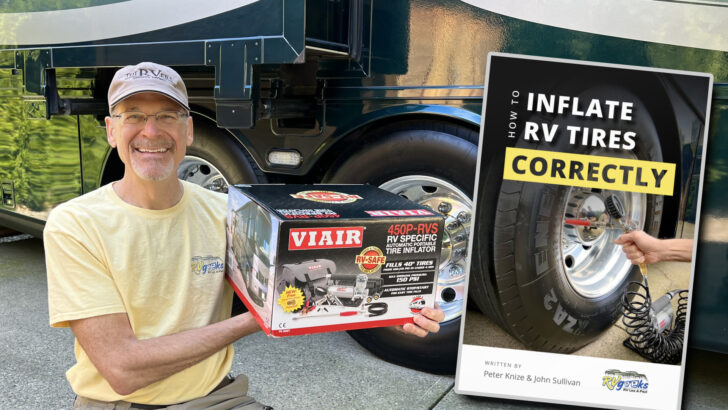
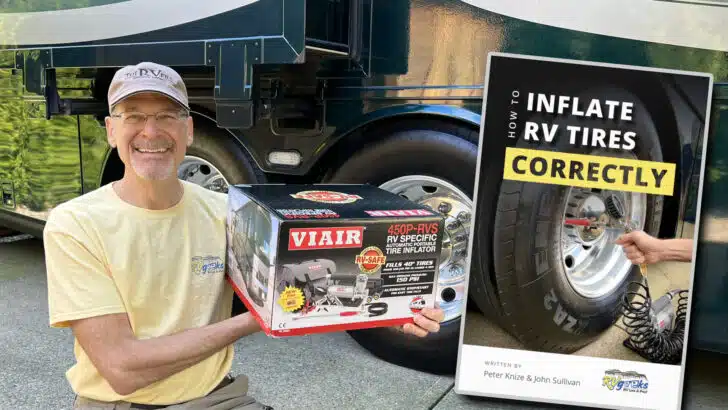
Our eBook How To Inflate RV Tires Correctly includes more details about cold tire inflation pressures, and access is FREE for our subscribers.
To see which portable tire inflator we use, check out our post about why we love our Viair compressor.
Free RVing Tips, Tricks, Reviews & Giveaways
As 20-year full-timers, we share everything we’ve learned about RVing over the years. Join our online community to receive a wealth of great RVing knowledge delivered daily to your inbox.
Whether you’re a new RVer or a seasoned full-timer, you’ll love the wide range of RVing topics we cover. Don’t miss a single article or any of our famous Giveaways. Subscribe to our newsletter today!
DJ
Friday 5th of January 2024
Thanks for the reminder on this. My situation is what to do when the air temperature is so wildly different (like here in the desert). What is the ideal outdoor temp to measure the tire pressure? It’s not uncommon for it to be 40 degrees in the morning before the sun comes up and then it gets warmer only on one side of the coach, and it’s 50 or 60 degrees by the time we’re ready to leave. Never been sure how to handle this situation.
DJ
Sunday 7th of January 2024
@TheRVgeeks, thanks so much - just what I was looking for.
TheRVgeeks
Saturday 6th of January 2024
Hi DJ! We SO get what you're talking about! We've had the same situation many times, and hate chasing the tire pressures up and down. Here is what we do, and suggest. Set your tire pressures based on the coldest typical temperature you experience in the location and season you're driving in. In your situation, we'd suggest that if driving days typically start out at 40 degrees in the morning, you set your tires at that time. The reason we do that is because, with one exception, ensuring that you don't drive on UNDERinflated tires is the biggest concern. That would happen if you set your tires when it's 60 out, but left your next campsite earlier than usual, when it's only 40 out. OVERinflated tires are not such a serious issue IF (and we stress that IF here) they won't be above the sidewall maximum when you DO depart when it's warmer out. That would only be a problem if your correct pressures were VERY close to the sidewall maximum. For example, the weight on our front axle calls for 110 PSI in our front tires. But the maximum stamped into the sidewall of the tires is 120. That means we can safely set our tires at 110 PSI in 40F temps, and if we depart later, or on any unusually warm morning, our 110PSI at 40 degree cold pressure would actually be higher (maybe 115-ish?) at 60 degrees. The main downside to running overpressure (again never above the sidewall max) is a slightly firmer ride, and a slight reduction in traction on wet surfaces. It does become a bit more annoying when there are BIG swings in temperature, especially if your tires require pressures very close to the sidewall max, as there's less "play" to work with. Barring that, our standard practice when in areas with large temperature swings is to keep the tire pressures just a bit higher by setting them on one of the colder mornings... and keeping an eye on the weather forecast. If we see that tomorrow is going to be 20-30 degrees higher than when we arrived, but we're not driving for another three days, when the forecast is for colder weather again, we absolutely don't let air out of the tires. Even if it's going to be a little bit warmer when we depart (maybe 10-20 degrees), we don't let air out. Again, letting pressures remain several PSI high during those warm-day drives is fine if the weather is just going to get cool again. The main things we NEVER do is check PSI when the tires are already in the sun, or after they've been driven on, since that throws things WAY off! Check 'em before the sun hits, and never let air out DURING your day's drive for any reason. Doing this, we end up having to adjust our tire pressures only a couple, or few, times a year, mostly when the season change, or we head to dramatically different climate. Hope this makes sense, and helps a bit! Safe Travels.
Ben Pace
Friday 5th of January 2024
Hello, Tire pressure has been a concern of mine for years. With my first 5th wheel RV I had problems with the tires and never knew if it was pressure or alignment. With my current 5th wheel I am determined to take care of the tires so that I do not have unexpected problems. One of the topics that I have not fully answered is pressure. I have tried to get a copy of your ebook on proper tire pressure but though I have followed your instructions to get the link, I never get the link. Would you please send the link to my email or post it somewhere so that I can learn your recommendations on proper tire inflation. Thanks, Ben Pace
Glen
Tuesday 9th of January 2024
@TheRVgeeks, may I also have a copy?
TheRVgeeks
Saturday 6th of January 2024
Hi Ben! We sent you an email with a direct link to the book. Please be sure to let us know if you didn't receive it. Hope this helps!
Hank
Friday 5th of January 2024
2013 cougar 28SGS was delivered with 225/75R15 D rated tire and Dot placard reconmented 65 lbs But I changed tires to Venom Power Primo Hauler All Steel 225/75R15 F rated 12ply But the PSI settings listed on your door jamb, DOT placard, or owner’s manual aren’t necessarily the correct pressures to set your tires to or tire size
TheRVgeeks
Saturday 6th of January 2024
Hi Hank! You are absolutely correct. But even with your original tires, the owner's manual, door jamb, and DOT placard almost certainly don't provide the correct tire PSI numbers. The best place to find the most accurate pressure ratings is in the tire manufacturer's inflation tables for the specific tire. We cover a huge amount about this topic in great detail in our eBook How To Inflate RV Tires Correctly, which is free for our subscribers. Not sure if you've seen the book, but we see that you're a subscriber, so you should have received a link to the book when you signed up. If you're having trouble finding that link, and want to access the book, please reply here and we'll be happy to send you a private link.
Gordon
Tuesday 2nd of January 2024
I don't own an inflator at my house...yet. I tow my 23' trailer about 4 blocks to a local tire shop for air checks before leaving on trips. Would those tires still be considered "cold" at that point?
Thanx in advance, G.
PS: Love your blog!!
TheRVgeeks
Tuesday 2nd of January 2024
Hi Gordon! Thanks so much for your kind words and excellent question. In our humble opinions, we would say that four blocks is such an incredibly short distance that we would not consider that enough to make any significant difference in tire pressures. If you want to confirm that, there’s an easy way to do it. Check your tire pressures before leaving the house and then check it again immediately prior to adding air at the gas station. If you see a 1 PSI increase, you can easily factor that into your pressures by setting them all 1 PSI higher than normal. If you see no change whatsoever, no accommodation would be needed. Hope this helps ! Safe travels.
William Burns
Wednesday 28th of April 2021
Just caught this video. Wow, it was helpful. Yesterday my tires were in the sun and the pressure was way up there. So, of course, I let some air out. This morning I went out before the sun was on them, you guessed it, they needed air! It will be interesting to see what difference a white tire cover makes on temperature and air pressure. I'll be ordering new ones next week based on your recommendation in a more recent video. Thanks for all the info, it is always helpful and appreciated.
TheRVgeeks
Wednesday 28th of April 2021
Hey William. Uggh... sorry to hear you went through that. There's nothing worse than doing something... that you then, immediately, have to UN-do. That's why the tire inflation information always says to check the pressure of "cold tires". We'd also be interested to hear whether the white tire covers make a difference in the tire temperatures in the sun... we've only ever had black. But we also only check our tire pressures when they're out of the sun, so it's never been an issue.